Summary:
Supermarkets and convenience stores are built for different customers, different locations, and different budgets. A supermarket franchise runs on volume: high footfall, large baskets, moderate margins across thousands of SKUs. A convenience store runs on speed: small baskets, higher per-item markups, fewer products. Your decision depends on capital, location type, and whether you want a volume game or a low-overhead operation.
What Is A Supermarket?
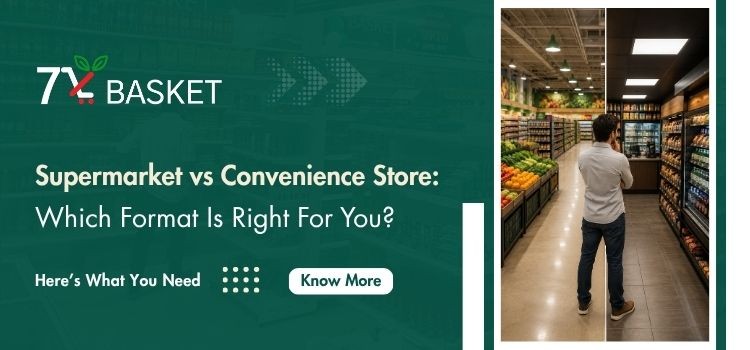
A supermarket is a large-format retail store that sells daily-need products across multiple categories under one roof. Customers visit supermarkets for planned, bulk shopping trips, typically once or twice a week. The format is designed around aisles, product zoning, and multiple billing counters.
A typical supermarket in India covers 500 to 10,000 sq.ft. and stocks 800 to 12,000+ SKUs. The product mix usually includes:
Grocery staples (rice, flour, lentils, cooking oil, spices)
Personal care (soaps, shampoos, skincare, hygiene products)
Beverages (packaged drinks, juices, tea, coffee)
Household items (cleaning supplies, detergents, home essentials)
Kitchen accessories (utensils, cookware, storage containers)
Stationery and crockery (pens, notebooks, plates, cups)
Wondering what sells fastest? Here's a breakdown of the most selling supermarket products across Indian stores.
The average customer spends ₹800 to ₹3,000 per visit and buys 15 to 40 items. Supermarkets earn through volume, not per-item markup. Gross margins typically range between 20% and 35%, depending on the product mix and the franchise brand's procurement strength.
Apply for 7x Basket, a Supermarket Franchise in India with 150+ stores and zero royalty for the first two years.
What Is A Convenience Store?
A convenience store is a small-format retail shop that sells a limited range of fast-moving products. Customers visit for quick, unplanned purchases, often daily or multiple times a week. The format is compact, usually a single room with one billing counter near the entrance.
A typical convenience store in India operates in 200 to 500 sq.ft. and stocks 200 to 800 SKUs. The product mix is narrower and focused on:
Packaged snacks and chips
Cold and hot beverages
Cigarettes and tobacco products
Toiletries and basic hygiene items
Ready-to-eat and packaged meals
Confectionery and impulse-buy items
The average customer spends ₹50 to ₹300 per visit and buys 1 to 5 items. Convenience stores earn through higher per-item markups (20% to 40%) but generate lower total monthly revenue compared to supermarkets. Operating hours are often extended, with some stores running 24/7.
Supermarkets VS Convenience Store
The table below puts the two formats next to each other on the metrics that matter most to someone picking a franchise format. If you're still figuring out how grocery franchise models work, start there before comparing formats.
Parameter | Supermarket franchise | Convenience store franchise |
Typical investment range | ₹10L to ₹2 crore (varies by brand) | ₹5L to ₹20L (varies by brand) |
Store area needed | 500 to 10,000 sq.ft. | 200 to 500 sq.ft. |
SKU count | 800 to 12,000+ | 200 to 800 |
Product categories | 5 to 6+ | 2 to 3 |
Average basket size | ₹800 to ₹3,000 | ₹50 to ₹300 |
Gross margin range | 20% to 35% (brand and mix dependent) | 20% to 40% (item dependent) |
Staff requirement | 3 to 12 | 1 to 2 |
Daily sales potential | ₹20,000 to ₹5L+ | ₹5,000 to ₹30,000 |
Break-even timeline | 12 to 24 months (typical) | 8 to 18 months (typical) |
Monthly running cost | ₹80,000 to ₹3L+ | ₹30,000 to ₹80,000 |
Disclaimer: All figures are indicative industry ranges. Actual numbers depend on the franchise brand, city, store size, and how well you run the store.
The investment range is wide because supermarkets come in different sizes. Not sure which size fits your budget? Read mini store vs super store vs hyper store to see how each tier compares on cost, space, and returns. You can also check a detailed look at the true cost of opening a supermarket before you finalize numbers.
Which Format Gives Better Profit Margins?
It depends on what you're measuring.
Convenience stores: Convenience stores earn higher margins per item. A packet of chips bought at ₹15 and sold at ₹20 is a 33% markup. A bottle of water bought at ₹8 and sold at ₹12 is a 50% markup. Individual product margins in this format can sit between 20% and 40%.
Supermarkets: Supermarkets earn lower margins per item but much higher absolute profit per month. Grocery staples carry 5–12% margins. FMCG products like soaps and packaged foods carry 15–25%. Blended across categories, most supermarket franchises in India report 20–30% gross margins. The monthly profit in absolute terms is higher because the sales volume is significantly larger.
The supermarket owner has more room to scale. The convenience store owner has fewer moving parts. Both formats can be profitable when matched to the right location and budget. If you're going with a smaller format, here's how to maximize profit in a mini supermarket franchise.
What Kind Of Location Works For Each Format?
Location is the variable most people underestimate. The right format in the wrong location loses money regardless of the brand.
Supermarkets perform best in:
Residential neighbourhoods with 2,000 to 5,000+ households nearby
Main roads and market complexes with consistent daily footfall
Areas near apartment clusters, housing societies, or gated communities
Locations where customers make planned weekly shopping trips
Convenience stores perform best in:
Highway stops and petrol station forecourts
Railway stations, bus terminals, and metro station exits
Office complexes, IT parks, and commercial zones
College campuses and hostel-dense areas
High-footfall streets where customers are moving through, not settling in
Here's a practical test: stand at the location for two hours on a weekday afternoon. If most people walking past are carrying bags and heading home, it's a supermarket location. If most are moving through quickly, it's a convenience store location.
If you're looking outside metros, the supermarket franchise opportunity in tier 2 and tier 3 cities is worth reading. Rents are lower, competition is thinner, and residential density in many of these cities is growing fast.
Which Format Has A Better Long-term Growth Path In India?
India's retail market crossed $1 trillion in 2025 and is projected to reach $1.5 to $1.6 trillion by 2030, growing at 10–12% annually. Food and grocery is the largest category within this, driven by daily demand and a steady shift from unorganized kirana stores to branded, organized retail. The rise of grocery store franchises in India tracks this shift in detail.
Supermarkets: Supermarkets are directly in line with this shift. As tier 2 and tier 3 cities grow, demand for well-stocked neighbourhood supermarkets with brand recognition and reliable supply chains is increasing. Franchise models benefit because the infrastructure is already built.
Convenience stores: Convenience stores have a market too, particularly in metros and transport hubs. But quick commerce apps (Blinkit, Zepto, Swiggy Instamart) now deliver essentials in 10–20 minutes, directly competing with the physical convenience store model. In areas with strong delivery coverage, the convenience store's core advantage (speed and proximity) is shrinking. We covered this in detail in quick commerce vs physical grocery stores.
If you're building for 5 to 10 years, the supermarket format has stronger structural tailwinds in India right now.
What Does The Day-to-day Operational Workload Look Like?
Running a supermarket is operations-heavy. On any given day, the store owner or manager is dealing with:
Inventory tracking across 5 to 6 product categories
Expiry date monitoring on perishable and packaged goods
Supplier coordination for daily or weekly restocking
Staff scheduling and training for 3 to 12 employees
Billing software management and daily sales reconciliation
Local marketing and customer relationship building
A franchise model takes a large part of this off your plate. Most supermarket franchises handle procurement, POS setup, staff training, and marketing centrally. But the store still needs an owner who shows up and watches the numbers.
A convenience store is simpler to run. The operational load includes:
Managing 200 to 800 SKUs with fast inventory turnover
Restocking from 1 to 2 suppliers
Running 1 billing counter with 1 to 2 staff
Tracking daily cash flow and shrinkage
The trade-off: most convenience store franchises in India don't provide the same depth of backend support that supermarket franchises do. You get less operational complexity, but you also get less infrastructure backing you up.
For first-time business owners with no retail experience, the supermarket franchise model has a steeper learning curve but comes with more guardrails. The convenience format is easier to start but leaves more on you after opening day. Either way, read through top mistakes to avoid when launching a grocery store in India before you commit.
If you're working with a tighter budget, here's a practical guide on starting a small budget grocery business that covers what's realistic at the lower end.
Final Thought
The format decision comes down to your capital, your location, and the kind of business you want to run. If you have the budget for a 500+ sq.ft. store in a residential area and want structured support with long-term growth potential, a supermarket franchise in India is the stronger path. If you're working with a smaller budget and a compact commercial space near a transit hub, a convenience store could work, but check what quick commerce is doing in your area first.