Summary:
India's food and grocery retail market is valued at approximately USD 740-780 billion in 2026, the third-largest food retail market globally. Organised grocery formats including supermarket franchises have grown their market share from 12% in 2019 to 18-22% today, expanding at 14-16% annually. Franchise-led grocery stores are now opening fastest in Tier 2 and Tier 3 cities, where rising incomes, digital payments, and lower commercial rents are creating the same conditions metros had a decade ago. Kirana stores still dominate by volume, but the structural shift toward branded, organised formats is underway and accelerating.
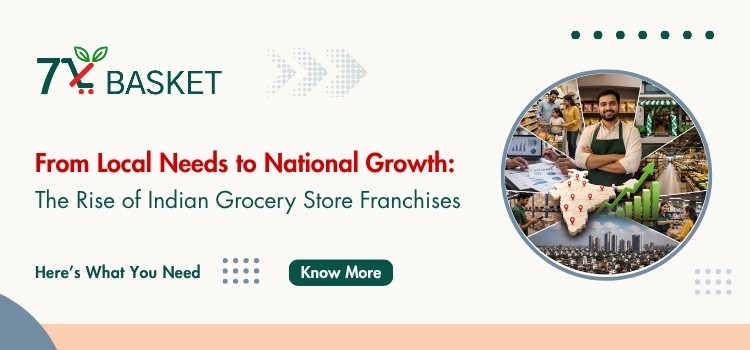
India has always been a nation of shopkeepers. For decades, the neighbourhood kirana was where every family bought atta, dal, and soap. It was personal, trusted, and local. That picture has not disappeared, but something alongside it has changed significantly. Across hundreds of cities and towns, branded supermarket franchise in India stores are opening next to, and sometimes replacing, those familiar corner stores. This is not a metro-only trend driven by aspirational retail. It is a structural shift in how India buys groceries, who owns the stores, and what those stores look like inside.
Why Is The Indian Grocery Franchise Sector Growing So Fast?
The scale of India's grocery market makes the foundation clear. India's food and grocery retail market is valued at approximately USD 740-780 billion in 2026, making it the third-largest food retail market globally behind China and the United States (IndexBox, April 2026). The market is projected to grow at 8-10% compound annual growth rate through 2035.
But raw market size does not explain why franchise models specifically are expanding. These forces do:
Household incomes in Tier 2 and Tier 3 cities have grown consistently. Families earning ₹2-6 lakhs annually are now buying branded packaged products they previously skipped. That spending shift creates direct demand for organised stores that stock those brands.
UPI and digital payment adoption have removed the friction that once kept shoppers loyal to cash-first kirana transactions. Consumers now expect digital billing, and organised stores deliver it.
Consumers who visit a branded supermarket once want the same experience consistently: clear pricing, product variety, hygienic storage, and a checkout system they trust. That consistency is something a standalone kirana is structurally not built to provide.
The franchise model gives first-time business owners a working system with supply chain access, brand recognition, and technology already in place. That lowers the barrier to entry for people with capital but no retail background.
Organised retail accounts for roughly 18-22% of total food and grocery sales in India in 2026, up from about 12% in 2019. That channel is growing at 14-16% annually while traditional formats grow at lower rates (IndexBox, April 2026). For a full breakdown of the investment case behind this growth, see top reasons to invest in a supermarket franchise business.
How Did India Shift From Kirana Stores To Organised Grocery Formats?
The shift is not a replacement story. It is a coexistence where the balance is tilting. Kirana stores still account for approximately 91% of grocery sales in India and are expected to retain an 86% market share even by FY30 (BusinessToday, June 2026). India has approximately 12-13 million kirana stores. Those numbers are not going to zero.
What has changed is which segment of consumers is moving, and where they are going when they do.
Kiranas were built on personal relationships, daily credit, and proximity. They typically carry 500-1,500 SKUs, run on a single owner-operator, and use largely manual systems for billing and inventory. That model works for habitual, daily-basket purchases. It starts to break down when:
A consumer wants a product the kirana does not stock.
They want a printed receipt for a business expense.
They want to compare prices across branded options.
They want the store to be consistently open during stated hours.
The franchise model fills that gap. It does not try to replicate the kirana's personal trust. It offers something different: brand recognition before a customer walks in, a supply chain that keeps shelves consistently stocked, and technology that makes billing and inventory reliable.
Understanding which most selling supermarket products drive the highest volumes, from staples and personal care to packaged beverages, is also how organised stores outcompete kiranas on the categories that matter most to daily shoppers. Around 10,000 modern franchise-led grocery outlets now operate across India, directly competing with larger retail chains in their respective catchment areas (Agro and Food Processing, 2024). For a closer look at which brands are building that presence, see top growing supermarket franchises in India.
What Makes Tier 2 And Tier 3 Cities The New Growth Frontier For Grocery Franchises?
Grocery franchise expansion in metro markets is hitting natural limits. Locations in Delhi, Mumbai, and Bengaluru are saturated, rents are high, and established competition is dense. The momentum has moved.
Tier 2 and Tier 3 cities are now the primary drivers of grocery franchise growth for four specific reasons:
Commercial rents are substantially lower. A 1,000 sq.ft. space in a city like Patna or Nagpur costs a fraction of what comparable space would in a central metro location. That directly improves unit economics for franchise operators working with tighter capital.
First-mover advantage exists in most smaller cities. Organised grocery retail is still rare in hundreds of residential pockets across Lucknow, Coimbatore, Indore, and similar cities. A branded store entering those markets faces limited organised competition.
Consumer aspirations have shifted. Shoppers in smaller cities want the same shopping environment available in metros: air-conditioned stores, clear product labelling, wide aisles, and consistent product availability. That demand exists but is largely unmet by current supply.
Entrepreneurs in smaller cities are actively looking for structured, lower-risk business models. Franchise retail provides a tested operational framework that independent store ownership does not.
Indian Retailer reported in December 2025 that the current momentum in grocery retail is coming from Tier 2 and Tier 3 cities, not metro markets. The Franchise India Report noted India had over 200,000 retail franchises by 2024, with non-metro markets accounting for a growing share of new openings (Ken Research, 2024). For entrepreneurs entering with limited capital, a small budget grocery business in a smaller city is often the lower-risk starting point precisely because overhead is more manageable and first-mover advantages are still available.
How Does A Grocery Franchise Compare To Running An Independent Store?
This is the core question most entrepreneurs entering the grocery business face. The honest answer depends on what they prioritise: control or structural support from day one.
Metric | Grocery Franchise | Independent Store |
Brand recognition | Available from day one | Built from scratch, takes years |
Supply chain | Centrally managed, bulk procurement pricing | Self-sourced, higher per-unit cost |
Technology (POS, inventory) | Provided and staff-trained | Self-arranged and self-funded |
Marketing | Brand-level campaigns plus local support | Entirely owner-managed |
Staff training | Structured onboarding before opening | Entirely owner-managed |
Royalty cost | Typically 0-2% of sales | None |
Break-even timeline | 12-24 months (structured benchmark) | Variable, no external benchmark |
Early-stage risk | Lower (proven operational model) | Higher (untested model) |
The royalty question matters in a low-margin category like grocery. A 1% royalty on sales sounds significant, but the supply chain savings from bulk procurement typically offset it. A standalone kirana pays full distributor margins, usually 5-8% above what a franchise operator pays through centrally negotiated pricing. Franchise gross margins in organised formats typically run at 25-30%, compared to 10-15% for a traditional kirana. Before deciding on a format, it also helps to weigh up the supermarket vs convenience store model, since the format determines your product range, staffing requirements, and capital structure from the start. For a more detailed side-by-side analysis, read the full breakdown on grocery franchise vs independent grocery store.
Brands like 7x Basket structure their franchise agreements to reduce early pressure specifically: zero royalty for the first two years, then 1% from Year 3. For a new operator, that provides a runway to stabilise operations before any royalty obligation begins.
How Is Technology Reshaping Grocery Franchises In India?
Five years ago, most grocery store owners ran on paper ledgers and manual stock counts. That approach is no longer viable for any format trying to compete in an organised retail environment.
Technology in organised grocery franchise operations in 2026 works at three levels:
At the store level, cloud-based POS systems, real-time inventory tracking, and automated expiry alerts reduce stock losses and manual billing errors. Predictive inventory management in organised retail has cut stockout incidents by over 25% compared to manual operations (Technavio, 2026).
At the supply chain level, digital B2B procurement platforms now reach over 12,500 postal codes in India, connecting store owners to thousands of FMCG sellers for daily or near-daily fulfilment. Franchise operators access this infrastructure through centrally negotiated procurement agreements.
At the customer level, loyalty programs, digital receipts, and sales analytics give franchise operators data on buying patterns that standalone store owners cannot access. That data drives restocking decisions with far more accuracy than gut-feel ordering.
The shift in 2026 is toward hybrid models: a physical store serving walk-in customers combined with WhatsApp-based ordering or app-based weekly subscriptions for regular households. Brands and franchise operators that build this into their systems from the start are capturing customer habits that would otherwise go to quick commerce platforms.
Can Grocery Franchises Hold Their Ground Against Quick Commerce Apps?
Quick commerce has genuinely changed grocery shopping behaviour in metro India. The 10-minute delivery model from Blinkit, Zepto, and Swiggy Instamart has real adoption in dense, high-income urban pockets. That cannot be ignored.
But the picture is more specific than the headlines suggest:
Quick commerce operates profitably only in dense, high-income urban geographies. In Tier 2 and Tier 3 cities, the order density, average basket size, and logistics economics do not support the model at scale.
Daily grocery purchases, particularly milk, bread, fresh produce, and loose staples, are still largely bought in person. Consumers in most Indian cities continue to prefer selecting fresh produce themselves.
Offline grocery stores carry operating costs of roughly 2-3% of revenue. Quick commerce platforms spend significantly more on delivery infrastructure, making them dependent on either high-volume locations or persistent subsidisation.
Franchise grocery stores increasingly serve a dual role: walk-in retail and a local fulfilment point for last-mile delivery through tie-ups with hyperlocal platforms.
Kirana stores are expected to retain 86% market share by FY30 (BusinessToday, June 2026). That figure includes both kiranas and organised offline stores. The real competition is not between grocery stores and quick commerce. It is between individual grocery operators competing for the same local customer base. Organised franchise stores have structural advantages in that competition.
What Should You Look For When Evaluating A Grocery Franchise In India?
Not every franchise produces the same outcome. Several operators get the headline numbers right but fail on execution. These are the factors that actually determine whether a grocery franchise works:
Royalty structure and timing. In a category with thin margins, when royalty begins and what it is calculated on directly affects monthly profitability. Confirm whether royalty applies before or after expenses.
Territory exclusivity. Without a written exclusivity clause, the same brand can open a competing store 300 metres from yours. Confirm the exact boundaries and have them written into the agreement.
Supply chain reliability. Daily or near-daily restocking is non-negotiable in grocery. Ask how the franchisor handles stockouts, lead times from manufacturers, and what happens when a specific product is temporarily unavailable.
Technology access. A cloud-based POS, real-time inventory management, and a business analytics dashboard separate genuinely modern franchise models from ones where the main asset is just the brand name on the fascia.
Post-launch support quality. Most franchise agreements look strong on paper for the setup phase. The real question is what support looks like after the first three months. Who is the dedicated point of contact? What is the response time for operational problems?
Scalability terms. Entrepreneurs planning to grow beyond one location should review single unit vs multi-unit grocery franchise terms before signing, since multi-unit rights, pricing, and territory obligations can differ significantly from a standard single-store agreement.
Franchises like 7x Basket build several of these into their model by default: zero royalty for the first two years, a dedicated relationship manager from day one, 24/7 backend support, and technology systems fully installed before opening day, across 150+ store locations in 100+ cities in India. For a complete walkthrough of every term to review before signing, the comprehensive guide to supermarket franchise covers the full checklist.
Conclusion
India's grocery franchise sector is growing because multiple forces arrived at the same time: rising household incomes across non-metro India, digital payment adoption, better supply chain infrastructure, and a generation of entrepreneurs looking for structured entry into retail rather than building from zero.
Tier 2 and Tier 3 cities are where the next decade of meaningful expansion happens. The kirana is not disappearing, but the customer segments shifting toward organised retail are real, growing, and accessible to well-run franchise operators. For anyone evaluating a grocery franchise opportunity in 2026, the market conditions are the most favourable they have ever been. The work is still in selecting the right brand, the right location, and the right level of operational discipline.