Quick Summary:
A grocery franchise gives you the right to run a store under an established brand, using its supply chain, billing system and operating standards.
India has four main models: FOFO, FOCO, COCO and COFO. A fifth, FICO, shows up in some deals. The difference is who owns the store and who runs it.
FOFO is the usual starting point for first-time owners. You own it, you run it, you keep the profit after royalty.
FOCO suits investors with higher capital who do not want to run daily operations. COCO is not open to outside investors at all.
A neighbourhood store starts at roughly ₹10 to ₹12 lakhs. Most well-run stores break even between 12 and 24 months.
Royalty percentage matters less than the royalty base. On sales, on margin or on profit changes your take-home a lot.
The model also decides who holds the FSSAI licence, who pays GST on the fee, and who owns the stock if you exit.
Organised grocery retail is spreading fast into tier 2 and tier 3 India, and most new stores opening today are franchises, not company outlets. That shift has put four short forms in front of first-time owners: FOFO, FOCO, COCO and COFO.
They look like paperwork. They are not. Before you sign anything for a Supermarket Franchise in India, the model decides who owns the store, who runs it daily, who carries a slow month, and who keeps the fit-out if the deal ends.
FOFO means you own and operate. FOCO means you fund it, the brand operates. COCO is the company's own store, not open to investors. COFO is rare in grocery. Here is how each one works.
What Is a Grocery Franchise Model?
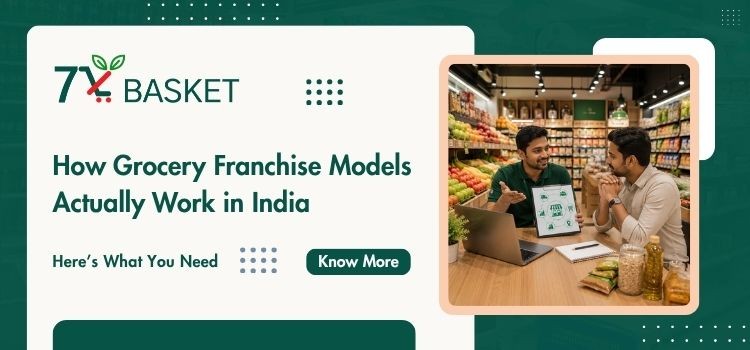
A grocery franchise is a licensing arrangement. A brand (the franchisor) gives you the right to open and run a supermarket under its name. You pay an upfront franchise fee for that right, plus ongoing royalties calculated from your monthly sales.
What you actually get with a grocery franchise:
A supplier network with pre-negotiated wholesale pricing
A billing and inventory management system, installed and ready
Staff training programs and operational guidelines
A store layout and product display standard
Brand-level marketing materials for campaigns and seasonal promotions
What you bring is the capital, the physical location, and the willingness to operate the store. The brand provides the infrastructure that would otherwise take two to three years to build independently. That is the practical value of a grocery franchise in India.
What Are the Four Main Types of Grocery Franchise Models in India?
Every supermarket franchise model in India falls into one of four structures. The model determines who owns the store, who runs it, and how profits are split. Knowing which one you are entering is more important than the franchise fee.
FOFO (Franchise Owned, Franchise Operated)
The franchisee owns the store and manages all daily operations. You invest in setup, hire and manage staff, control inventory, and keep the profit after paying royalty to the brand. This is the most widely used model in neighborhood supermarket franchises across India.
FOCO (Franchise Owned, Company Operated)
The franchisee invests in setting up the store but the brand runs daily operations. The company manages staffing, inventory, and customer service. You receive a return on your investment, usually as a fixed payout or revenue share, without managing operations yourself.
COCO (Company Owned, Company Operated)
The brand owns and operates the store entirely. Reliance Fresh and DMart run on this basis. This model is not open to individual investors. It is corporate retail expansion, not franchising.
COFO (Company Owned, Franchise Operated)
The company owns the store infrastructure and a franchisee manages operations. Less common in the grocery sector, used in select formats by specific brands.
Model | Who Owns the Store | Who Runs It | Best Suited For |
FOFO | Franchisee | Franchisee | Entrepreneurs who want full ownership and control |
FOCO | Franchisee | Brand/Company | Passive investors with higher capital (₹50L+) |
COCO | Franchisor | Franchisor | Corporate expansion, not available to investors |
COFO | Franchisor | Franchisee | Specific brand-driven arrangements |
For most first-time entrepreneurs looking at grocery franchise models in India, FOFO is the default entry point. It is also where the highest profit upside sits. If you want to compare specific brands currently operating across these models, see the overview of top-growing supermarket franchises in India.
How Does Money Actually Flow in a Grocery Franchise?
The upfront franchise fee is what most people focus on. It is not what determines long-term profitability. The ongoing cost structure is what matters.
Upfront Investment Breakdown for a Neighborhood Grocery Franchise:
Franchise fee: ₹1.5 lakhs to ₹20+ lakhs depending on brand and store format
Store setup and interior: approximately ₹1,000-₹1,500 per sq.ft.
Initial inventory: approximately ₹1,000 per sq.ft.
Billing software and technology: ₹30,000-₹50,000
For a detailed breakdown by store size, including licensing fees and costs most investors overlook, read the full guide on what it actually costs to open a supermarket in India. If your capital is under ₹15 lakhs, there are grocery business models designed for tighter budgets worth reviewing before you settle on a format and size.
Monthly Running Costs for a 500 sq.ft. Store:
Rent: ₹15,00*- ₹17,500* (at ₹30-₹35 per sq.ft.)
Electricity: ₹6,000-₹7,500* (at ₹12-₹15 per sq.ft.)
Staff (minimum 3 people): ₹30,000*
Miscellaneous and contingency: ₹10,000-₹20,000*
Customer discount (5% of monthly sales): scales with revenue
The Royalty Distinction That Most Articles Miss
Royalties differ not just in percentage but in what they are calculated on. Some brands charge royalty on total monthly revenue. Others charge it on net profit. This changes your actual take-home significantly.
If your store does ₹7 lakhs per month and a brand charges 5% royalty on revenue, you owe ₹35,000 before a single expense. If the same 5% applies to your net profit of ₹80,000, you owe ₹4,000. Ask specifically which basis applies before you sign the agreement.
Gross margins in Indian grocery retail run at 25-30% on MRP. After standard customer discounts of 5% on sales, effective gross margin settles between 20-25%. Net profit for a well-managed 500 sq.ft. store, after all operational costs, typically falls in the ₹50,000-₹1,00,000 range per month.
How Does a Grocery Franchise Compare to Running a Kirana Store?
The difference is structural, not just cosmetic. A kirana store owner negotiates supplier rates individually every month, deals with stockouts because there is no forecasting system, and builds customer trust from zero because there is no brand recognition. A franchise owner enters with pre-negotiated supply chain rates, a working billing system, and a brand customers already recognize.
Factor | Independent Kirana Store | Grocery Franchise |
Supplier pricing | Negotiated individually, typically at market rate | Pre-negotiated by the brand, usually lower input cost |
Brand recognition | Built from scratch, takes years | Present from opening day |
Billing and inventory | Manual or basic, usually no tracking | Pre-installed POS with live inventory management |
Staff training | Informal, owner-driven | Provided by franchisor at setup stage |
Marketing support | Entirely the owner's cost and effort | Brand campaigns, launch support, seasonal materials |
Royalty | None | Ongoing, varies by brand and model |
The honest tradeoff: you give up full product choice and pricing flexibility. You stock what the brand approves and price within their guidelines. For most first-time owners, that structure reduces errors more than it limits opportunity. For kirana store owners with years of supplier relationships and a loyal existing base, it is worth weighing whether the brand value justifies the fee structure on their specific numbers. A detailed profitability comparison between the two paths is covered in the grocery franchise vs independent grocery store breakdown.
What Does a Franchisor Actually Provide, and When Does Support Taper Off?
Every franchise brand promises support. What that looks like in practice has a timeline.
Pre-Launch Support (Typically 4-8 Weeks Before Opening):
Store layout planning and interior vendor coordination
Initial inventory selection and first order placement
Billing software installation and staff training
Pre-launch marketing: social media setup, WhatsApp outreach, local flyers
Post-Launch Support (Ongoing, But with Reducing Intensity):
Restocking guidance and order management support
Brand-level seasonal and festive marketing materials
Remote troubleshooting for software and operational issues
What Typically Stops or Slows After 60-90 Days:
Daily check-ins from the franchisor field team
On-site presence from brand representatives
Active local marketing spend specific to your store
The practical reality is that the first 90 days after launch are the most actively supported period you will have. Once that window closes, inventory management becomes entirely your responsibility. A practical guide on how to manage grocery store inventory without losing money covers what to prioritize once you are operating independently. Store owners who build solid operating habits, train staff properly, and set up local customer acquisition channels (WhatsApp groups, housing society outreach, Google Business profile) during those first 90 days consistently outperform those who rely on continued franchisor involvement.
Which Grocery Franchise Model Suits First-Time Investors in India?
FOFO is the right starting point for most people at the ₹10-25 lakh investment range. The reasoning is direct: at this investment level, your best protection is your own presence in the store. No hired manager at ₹15,000-₹20,000 per month will manage margins with the same attention as an owner who has money on the line.
FOCO makes economic sense when:
Your investable capital is ₹50 lakhs or more
You own property in a high-footfall location, which significantly reduces rent costs
You have stable income from another source and want grocery retail as a secondary investment
At smaller investment levels, FOCO's management fee structure often leaves the returns too thin to be worth the trade-off of giving up operational control.
One group that consistently outperforms in FOFO franchises in India: existing kirana store owners who upgrade to a branded format. They already understand inventory cycles, seasonal demand patterns, and local customer behavior. What they gain from a franchise is procurement efficiency and brand credibility. What they give up is some product selection flexibility, which matters less once the brand brings in new foot traffic they previously had to earn slowly.
Before thinking about a second or third store, it is also worth understanding the single-unit vs multi-unit grocery franchise decision. In grocery retail specifically, the second store does not inherit the first store's customer base because shoppers are hyperlocal. Getting one unit to consistent profitability is always the right first step.
How Long Does It Take to Break Even in a Grocery Franchise in India?
Most grocery franchise stores in India break even within 12-24 months. The range is wide because location and execution determine the outcome more than the brand name on the store.
Conditions That Bring Break-Even Closer to 12 Months:
Opening in a Tier 2 or Tier 3 area with no organized grocery competition nearby
Owner actively present in the store for the first year
Inventory turning over every 25-30 days (not sitting for 45+ days)
Early investment in local marketing: housing society outreach, WhatsApp groups, Google Business profile
Conditions That Push Break-Even Toward 24 Months:
High rent relative to actual footfall
Heavy competition from established players within 500 metres
Absentee ownership with a salaried manager handling all operations
Slow-moving inventory held too long, locking up working capital
A 500 sq.ft. store in a Tier 2 city with no organized competition nearby, managed by an engaged owner-operator, typically recovers investment within 12-18 months. The same investment in a saturated urban market with three competitors nearby tends to take 18-24 months.
What Should You Check Before Signing a Grocery Franchise Agreement?
Before committing to any supermarket franchise model, verify these five things:
Royalty Basis: Is it charged on monthly revenue or net profit? At what percentage? Does the rate change after the first or second year?
Territory Protection: Does the agreement prevent the brand from opening another outlet in your immediate catchment area?
Training Scope: What is included, over what duration, and is follow-up training available after launch?
Exit Terms: What penalties apply for early termination, and what happens to your fit-out and unsold inventory?
Franchisee References: Ask the brand for contact details of two or three active franchise partners and call them directly.
The last point is the most reliable filter and the most underused. Any brand confident in its model provides references without hesitation. For a step-by-step walkthrough of how the application, site evaluation, and store launch actually unfold with one specific brand, the guide on how to start a supermarket franchise in India with 7x Basket covers the full process.
Final Thought
Grocery franchise models in India give you a real shortcut into organized retail, but they are not passive income. The FOFO model, where you own and operate, is the standard entry point for first-time entrepreneurs, and for good reason: ownership gives you the incentive to manage margins properly. FOCO works at higher investment levels for investors who want returns without day-to-day operations. Whichever model you choose, location, inventory management, and owner involvement determine whether a store breaks even in 12 months or 24, not the franchise brand alone.
If you are looking at a Supermarket Franchise in India with zero royalty for the first two years, 150+ active partners across 100+ cities, and end-to-end setup support, 7x Basket is worth a call.