60 Seconds Summary:
Kirana store owners are upgrading to supermarkets because self-service shopping and quick commerce apps have shifted what customers expect from a neighborhood grocery run. A typical kirana to supermarket transformation costs ₹10 lakh to ₹15 lakh for a mid-size store, covering shelving, POS software, inventory, and branding. The steps to upgrade a kirana store into a supermarket run in a fixed order: evaluate the space, redesign the layout, expand inventory, install POS technology, train staff, and complete legal compliance. Store owners can do this in phases without shutting the shop, and margins on converted, organized-format stores often move from single digits into the high teens. A franchise route removes much of the guesswork that trips up first-time owners.
Why Are Kirana Store Owners Upgrading to Supermarkets?
Kirana owners are upgrading because customer expectations have moved faster than the counter-service model can match. Shoppers now want to browse, compare brands, and check prices themselves instead of asking a shopkeeper to fetch every item off a shelf they can't see.
Quick commerce apps have added pressure on top of that shift. Platforms promising delivery within 10 to 15 minutes now compete directly for the same daily-essential purchases that used to be a kirana store's most reliable business, especially in metro neighborhoods. Staying a counter-only shop means competing on convenience against an app, a fight most single-owner stores lose.
The opportunity hasn't disappeared, though. India's organized retail sector is projected to grow at a CAGR of 11.4 percent between 2026 and 2035, according to Expert Market Research's India Retail Market Report. Most of that growth comes from existing kirana stores formalizing into branded, franchise-backed formats, not from new players replacing them. Upgrading is how a store claims a share of that growth instead of losing customers to it.
How Is a Kirana Store Different From a Modern Supermarket?
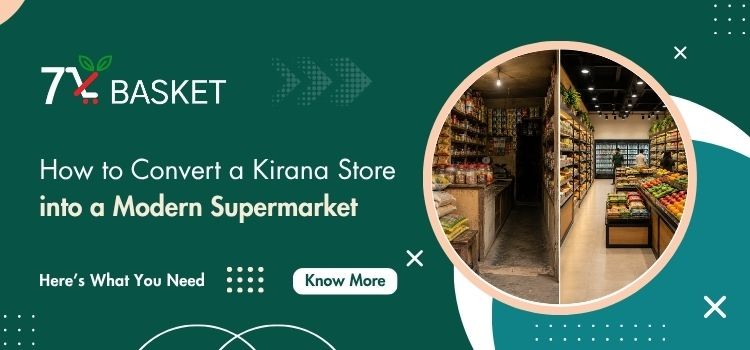
A kirana store runs on a counter model, where the shopkeeper controls access to stock. A supermarket runs on self-service, where customers browse open shelves and billing happens through a POS system at checkout. That's the same divide that separates a supermarket from a convenience store.
Aspect | Kirana Store | Modern Supermarket |
Shopping style | Counter-based | Self-service |
Billing | Manual cash register | POS with digital records |
Product range | 300 to 1,500 SKUs, local brands | 800 to 5,000+ SKUs, multiple categories |
Customer credit | Informal udhaar | Loyalty programs |
Udhaar, or informal credit, is a cost kirana owners rarely put on paper. A 2026 review of kirana running costs by SuperK Supermarket puts outstanding udhaar at ₹10,000 to ₹50,000 per store, some of which never gets collected. Billed transactions make that amount visible instead of buried in a notebook.
How Much Does a Kirana to Supermarket Transformation Cost?
A mid-size transformation costs ₹10 lakh to ₹15 lakh, covering store setup, inventory, branding, and billing technology. That range comes from BuyBuyCart, a Noida-based grocery platform that has converted stores across India. Smaller, budget-friendlier conversions cost less.
Cost head | What it covers | Typical range |
Layout and shelving | Racks, counter, signage | ₹1.5L to ₹4L |
POS and billing software | Software plus staff training | ₹40,000 to ₹1L |
Inventory upgrade | Wider stock, opening fill | ₹4L to ₹8L |
Branding | Storefront, in-store branding | ₹50,000 to ₹1.5L |
The upgrade changes the margin structure too. A typical unorganized grocery store runs on margins of 8 to 9 percent; owners who convert to an organized, branded format report margins closer to 17 percent, according to BuyBuyCart's founders. Any small grocery store to supermarket business plan should separate this setup cost from monthly running expenses like rent, salaries, and electricity. Owners who budget only for the fit-out often run short on working capital by month two.
What Are the Steps to Upgrade a Kirana Store Into a Supermarket?
The steps to upgrade a kirana store into a supermarket run in a fixed sequence: evaluate the space, redesign the layout, upgrade inventory, install billing technology, train staff, and complete compliance. Ordering new stock before the layout is finalized is one of the most common reasons conversions run over budget.
Step 1: Evaluate Your Space
Confirm the shop can support open shelving and free customer movement before touching the layout. Stores as small as 500 square feet can convert successfully as a mini store format with the right aisle width and checkout flow. A structural walk-through at this stage, not after shelving is ordered, is what prevents costly rework later.
Step 2: Redesign the Store Layout
Move products from behind the counter onto open shelves, grouped by category, with a clear sightline from the entrance to the billing counter. Placing high-frequency items like milk, bread, and staples toward the back of the store, a layout principle used across organized retail, increases the distance customers walk past other categories before reaching what they came for.
Step 3: Upgrade Your Product Range
Add national and regional brands alongside the store's existing local stock, guided by what customers already buy rather than what looks impressive on a shelf. Once a POS system is running, its sales data gives far more reliable stocking guidance for the next round of purchasing than a manual billing register ever could, since manual billing rarely tracks which SKUs actually move fastest.
Step 4: Install POS and Billing Technology
Replace manual billing with a system that tracks stock in real time and cuts errors at checkout. Beyond faster billing, a POS system produces sales reports by category, the same data a franchise support team uses to decide what to stock more or less of at a given store.
Step 5: Train Staff for a Self-Service Floor
Self-service does not mean unstaffed. Train the team to guide customers, answer product questions, and run the billing system without slowing the queue. Owners who skip this step often find that a self-service floor without trained staff frustrates customers more than the old counter model did, since no one is available to help locate items across a bigger space.
Step 6: Complete Legal Compliance
Update GST registration, apply for an FSSAI license if the store doesn't already hold one, and confirm the local trade license covers a larger store format. This step gets missed more often than any other because it never shows up on a walkthrough of the store, but operating a bigger format without updated registration creates exposure that grows with the size of the business.
Once these six steps are done, a grand opening checklist built to drive footfall helps turn first-week visitors into repeat customers.
Should You Convert Independently or Through a Franchise?
Both paths work, and the franchise versus independent grocery store tradeoffs are worth weighing directly. Converting independently gives full control over sourcing, layout, and pricing, but it means building supplier relationships, technology, and staff training from scratch. A franchise hands over a working system in exchange for a share of long-term revenue.
7x Basket is one option built for this transition. Franchisees get store design, product procurement, technology, and marketing support from a team with more than 5 years in the grocery franchise sector, plus zero royalty for the first 2 years. Platforms like BuyBuyCart and SuperK Supermarket run similar models elsewhere in the country, so compare specific systems, not the franchise-versus-independent label: how much support each includes, what it costs, and whether the territory fits your location.
Ask any franchisor about its royalty-free period, territory ownership, and what support looks like once the store is open; our rundown of reasons to invest in a supermarket franchise business covers what's worth asking. 7x Basket runs across 150+ locations in 100+ cities, part of a broader Supermarket Franchise Opportunity in Tier 2 & Tier 3 Cities, giving new franchisees supplier pricing and processes tested well beyond a single store.
What Mistakes Should You Avoid During the Conversion?
The most common mistake is treating the conversion as a decoration project instead of an operations change, one entry on a longer list of mistakes to avoid when launching a grocery store in India. New shelving means little if the inventory, staffing, and billing behind it stay the same.
Overstocking before demand is proven: wide inventory in month one ties up cash and raises the risk of expired stock on shelves.
Skipping staff training: a self-service floor needs staff who can guide customers and run the POS system, a different skill than handing over items from behind a counter.
Underestimating working capital: setup costs are one-time, but rent, salaries, and restocking are monthly, and owners who spend their full budget on the fit-out often run short within the first quarter.
Conclusion
Converting a kirana store into a supermarket is a sequencing problem more than a spending problem. Get the space evaluation, layout, inventory mix, and billing technology right, and the rest of the format follows. The investment lands around ₹10 lakh to ₹15 lakh for a mid-size store, and the payoff shows up in margins that move from single digits into the high teens once the store runs in an organized format. If building those systems from scratch feels riskier than you want, a 7x Basket supermarket franchise gives you that structure already in place, with zero royalty for the first 2 years. A conversation with the team costs nothing, and our guide on how to start a supermarket franchise with 7x Basket covers what happens next.