60-Second Summary
A grand opening footfall checklist breaks into 10 specific actions, from building your Google Business Profile and WhatsApp list through to soft opening, launch day execution, and holding back budget for week two, each timed against a countdown to opening day. India had over 200,000 retail franchises by 2024 according to the Franchise India Report, and organized retail is projected to grow from US$132 billion in 2024 to US$230 billion by 2030 per IBEF, so a new store is launching into a crowded field. A soft opening 3 to 7 days before the public launch lets you test billing, staff, and stock flow on a small crowd before real footfall arrives. Footfall on grand opening day comes from hyperlocal tactics such as a Google Business Profile set up early, WhatsApp broadcast lists, and direct outreach to Resident Welfare Associations (RWAs), not broad advertising. Footfall after week one depends on full shelves and trained staff, not on how loud the launch marketing was.
What Should Be on a New Supermarket Opening Checklist?
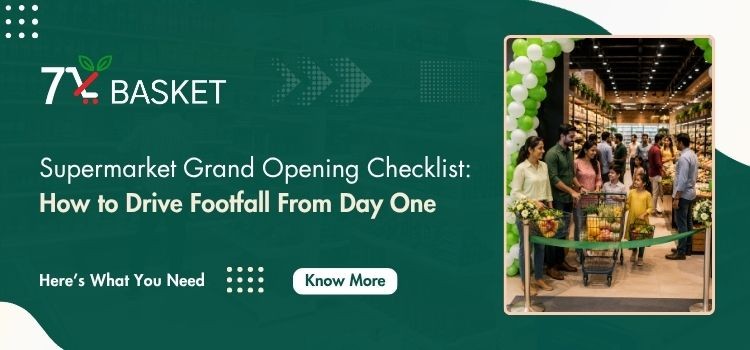
This checklist assumes the groundwork, registration, lease, store fit-out, POS setup, opening stock, and trained staff, is already in place. If any of that is still pending, sort it first: see how a supermarket franchise works in India for the franchise process and the true cost of opening a supermarket for budgeting. From here, a new supermarket opening checklist, a grocery store opening checklist, or a store launch checklist, whatever you call it, is entirely about what gets people through the door on day one. The 10 actions below cover that, each tied to a specific countdown point before opening day.
Phase | Timeframe Before Opening | Covers |
Build pre-launch reach | 3 to 4 weeks out | Google Business Profile, WhatsApp list, RWA outreach |
Lock the launch plan | 1 to 2 weeks out | Date, hours, discount items |
Final week | 7 days out | Soft opening, staff roster |
Launch day and after | Day 0 onward | Loyalty capture, ribbon-cutting, week-two budget reserve |
1. Claim and Optimize Your Google Business Profile
Claim your Google Business Profile 2 to 4 weeks before opening and fill in the address, hours, photos, and category so "grocery store near me" searches surface it by launch day. A profile claimed the week of opening doesn't have time to rank, which means the single highest-impact, free channel for footfall sits unused on the day it matters most.
2. Build Your WhatsApp Broadcast List
Start collecting phone numbers from neighborhood visits and flyer drops 2 to 3 weeks before opening, not after. This list becomes the backbone of every other footfall tactic on this checklist, from soft opening invites to the week-two follow-up message, so the earlier it starts growing, the more it's worth on launch day.
3. Reach Out to Local RWAs and Housing Societies
Identify the Resident Welfare Association contacts for nearby housing societies and ask to share your opening in their WhatsApp group or notice board. Most RWAs run an official channel that reaches hundreds of households directly, at no cost, and it carries more trust than a flyer because it comes from a source residents already follow.
4. Confirm Your Grand Opening Date and Hours
Lock your date and operating hours against your area's festival and monsoon calendar, not a generic date that ignores both. A date that clashes with either can undo weeks of WhatsApp and RWA groundwork in a single afternoon, no matter how well everything else on this list gets executed, so confirm it before you build the rest of the plan around it.
5. Plan Your First-Day Discount Items
Pick 4 to 5 fast-moving staples, atta, rice, edible oil, milk, and cut their price for day one only, instead of running a storewide discount. Shoppers in Indian grocery retail price-compare these exact items against the kirana store next door, so a sharp number on a handful of staples does more to pull in footfall than a flat percentage off everything.
6. Run a Soft Opening for Neighbors and RWA Members
Open quietly to a small invited group, immediate neighbors and RWA members, 3 to 7 days before the public launch. Use it to test billing speed, shelf gaps, and staff response under real conditions, and collect feedback through the WhatsApp group built earlier rather than a formal form, since response rates run higher there for this audience.
7. Brief Your Staff on the Launch Day Roster
Confirm who's on billing, who's on restocking, and who's handling customer questions before launch morning, not on it. A confused floor plan on the one day with the most footfall and the most scrutiny costs more goodwill than almost any other single mistake.
8. Set Up Loyalty Number Capture at Checkout
Capture a phone number at every checkout on launch day, framed as loyalty enrollment rather than a data request. That list is what lets you reach day-one shoppers again in week two without spending on ads, and it only works if the capture habit starts on day one, not whenever someone gets around to it.
9. Arrange a Ribbon-Cutting Moment
Book a short ribbon-cutting with a recognized local figure, a councillor, a school principal, someone the neighborhood already trusts. It signals legitimacy faster than any banner, and it gives local WhatsApp groups something to share that a discount alone doesn't.
10. Hold Back Budget for a Week-Two Follow-Up
Set aside a portion of the grand opening budget before launch day so there's something left to spend once the opening rush fades. The phone numbers captured at checkout are only useful if a follow-up message actually goes out, and spending everything on day one means that message never gets sent.
How Far in Advance Should You Start Planning Footfall for a Grand Opening?
Start building footfall 3 to 4 weeks before opening day at minimum, since that's how long a Google Business Profile takes to rank and a WhatsApp list takes to grow to a useful size. Waiting until the week of launch to start any of this means showing up to opening day with no one outside the immediate street aware the store exists.
Indian retail has a timing variable most generic footfall advice skips: the festival and weather calendar. Launching just ahead of a regional festival can multiply day-one footfall because shoppers are already in a buying mindset, but it also means competing for vendor stock and contract labor during the busiest weeks of the year. Launching during a heavy monsoon stretch in a flood-prone locality can flatten footfall regardless of marketing spend, so check the historical weather pattern for that specific street, not the season in general.
What Marketing Actually Drives Day-One Footfall?
The marketing that drives footfall to a new store on day one is hyperlocal, not broad. Google Business Profile, WhatsApp, and RWA outreach do most of the work, covered in the checklist above, but here's how the channels compare once you're deciding where to put time and budget.
Channel | Lead Time Needed | Footfall Impact | Cost Level |
Google Business Profile | 2 to 4 weeks to rank | High for "near me" search | Free |
WhatsApp broadcast / RWA outreach | 2 to 3 weeks list building | High, hyperlocal | Free to low |
Local flyers and banners | 1 to 2 weeks | Medium | Low |
Geo-targeted social ads | 1 to 2 weeks | Medium | Low to medium |
Local creator or influencer visit | 2 to 4 weeks to book | Medium to high | Low to medium |
How wide a radius you need to cover depends on store format. A Mini Store pulling shoppers from a single residential pocket can run on WhatsApp and RWA outreach alone, while a larger format drawing from a wider catchment needs geo-targeted ads and a creator visit to reach people outside immediate walking distance. Competition and channel costs also shift across Supermarket Franchise Opportunities in Tier 2 & Tier 3 Cities compared to a metro. Franchise support that includes local marketing guidance and ready-to-use promotional materials, which is part of what 7x Basket provides under its franchise terms, covers most of this groundwork before the owner has to build it alone.
How Do You Drive Footfall on Grand Opening Day Itself?
Showing up matters more than simply existing, on grand opening day. People need a specific, time-bound reason to walk in, not just an announcement that the store is open. Sweepstakes and gift-card giveaways, the kind that work for a US big-box launch, matter less here than the price drops on a handful of items already planned in the checklist above, the kind of items that turn up on most lists of the top-selling supermarket products in India.
Beyond pricing, two things consistently add to footfall on the day itself: first 100 or 200 customer perks using small, useful branded items rather than generic giveaways, and live sampling of 2 to 3 fast-moving FMCG categories that brands often co-fund. Both work better alongside the loyalty capture and ribbon-cutting already on the checklist than as standalone tactics.
How Do You Keep Footfall Going After the First Week?
The opening-day crowd always thins out within a week or two, and that's normal, since curiosity visitors don't automatically turn into repeat shoppers. What decides whether the traffic settles into a habit instead of disappearing entirely is whether the third visit feels as good as the first one: same availability, same service, same prices.
Two habits protect that. A weekly feedback check with regular shoppers, even an informal one at the billing counter, tells you what's missing from the shelf before it costs you a customer. And the phone numbers collected at launch, from item 8 on the checklist, turn into the week-two nudge promotion funded by the budget held back in item 10, a far cheaper repeat-visit lever than another round of paid ads. For a closer look at what protects margin once the opening rush fades, see how to maximize profit in a mini supermarket franchise.
What Mistakes Kill Footfall at New Store Launches?
New supermarket launches lose footfall less from a single bad decision and more from small gaps in the footfall plan itself. Our broader list of mistakes to avoid when launching a grocery store in India covers the operational ones; five mistakes specific to footfall account for most of the damage here:
Running out of stock on the exact items featured in the opening-day discounts, which undoes the reason people came in and shows up right when scrutiny is highest
Spreading a generic storewide discount instead of concentrating it on just a few fast-moving items, which costs margin without creating anything memorable
Sending a launch day team that doesn't reflect the neighborhood, missing the local-language fluency and trust a familiar face brings to the billing counter on day one
Finding gaps during the soft opening and not actually closing them before the public launch, so the same problems repeat in front of a much bigger crowd
Spending the entire grand opening budget on day one and holding nothing back for a follow-up message to the list collected at checkout once the initial rush fades, a mistake that hurts most for anyone running a low-budget grocery business with the least room for error
Conclusion
A grand opening footfall plan works when it's tied to a calendar, not a wish list: the 10 actions above, sequenced backward from launch day, a soft opening used to catch problems early, and a follow-up message already funded before day one even arrives. Footfall on day one matters, but footfall in week six matters more, and that comes down to operations rather than promotion: full shelves, a trained team, and systems that catch problems before customers do. None of this requires a large marketing budget if the groundwork is done early enough. For owners weighing the franchise route against building all of this alone, our comparison of franchise vs. independent grocery stores breaks down that trade-off in more depth.
A franchise model like 7x Basket also runs seasonal and festive marketing support alongside the local push covered here, with zero royalty for the first two years to free up cash during exactly this phase. If that kind of backing fits what you're looking for, see how to start a 7x Basket franchise for the full step-by-step process.