Quick Summary
This guide lists the top 20 products every Indian supermarket should stock from day one, with category margins and honest stocking advice.
Rice, atta, dal, edible oil, packaged milk, and tea are the six backbone products. These drive weekly footfall before anything else does.
Biscuits, personal care, dry fruits, agarbatti, and millet-based products carry the best margins, ranging from 15% to 30%.
Staples bring customers in. Personal care, snacks, and beverages are where you build actual margin on those baskets.
National brands anchor each category. Regional or loose options can supplement once you see what your locality actually buys.
The right product mix depends on who lives within 1 to 2 km of your store, not just what sells nationally.
Millet-based products are the fastest-growing category to add right now, with margins of 18% to 30% and limited competition from unbranded alternatives.
New store owners: start with this full list, track sell-through in the first 60 days, then stock deeper on your top movers.
If you're opening a supermarket franchise or trying to improve what's on your shelves, the product list you start with matters more than most people realise. The wrong mix means dead stock, poor cash flow, and customers who leave to shop elsewhere. The right mix means steady footfall, repeat purchases, and margins that compound over time.
If you are ready to open your own store, learn more about the supermarket franchise in India model that 7x Basket offers.
This guide covers the top 20 products every supermarket franchise owner in India should stock.
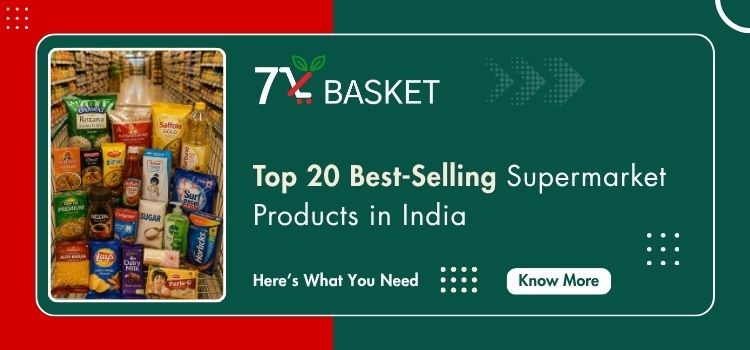
20 Best-selling Supermarket Items In India
1. Rice
Rice is the single highest-volume staple in any Indian supermarket. South Indian customers buy Sona Masoori and parboiled varieties; North Indian customers buy Basmati for everyday meals and Basmati premium for festivals. Stock both. Rice drives weekly visits and builds the habit of your store being the first stop for household needs. Margins are low (3-6%), but the volume justifies the shelf space.
2. Wheat atta
Whole wheat atta is non-negotiable in every household. Brands like Aashirvaad, Shakti Bhog, and Pillsbury move reliably across all income segments. With millet-based atta (ragi, jowar, bajra) recording strong growth in 2026 among health-conscious buyers, stocking a mix of standard and multigrain variants gives you reach across both mainstream and premium shoppers.
3. Pulses and dal
Toor dal, chana dal, moong dal, and masoor dal are bought monthly in bulk across most Indian households. This category has good margins (8-12%) compared to rice and atta. The Tata Sampann range and unbranded loose pulses both sell well, depending on your customer base. Keep branded and loose options available.
4. Edible oil
Sunflower, mustard, and groundnut oils are daily-use products with predictable demand. Brands like Fortune, Saffola, and Dhara dominate. Edible oil has thin margins (2-5%) but very high rotation, which makes it valuable for cash flow. Buying in larger packs (5L, 15L) and stocking smaller consumer packs gives you flexibility.
5. Packaged milk and dairy
Milk, curd, paneer, and butter are daily-purchase products that bring customers in even when they're not doing a full grocery run. Partner with Mother Dairy, Amul, or Parag depending on your region. Dairy creates the kind of daily footfall habit that benefits every other product category in your store.
6. Salt, sugar, and basic spices
Salt and sugar are bought every household visit. Pre-packaged spice mixes from brands like MDH, Everest, and Catch move steadily throughout the month. These are small-ticket items, but their frequency means they add up. More importantly, a customer who cannot find basic spices in your store will question whether your store stocks everything they need.
7. Biscuits and cookies
This is one of the highest-margin categories in a supermarket. Parle-G, Britannia Good Day, Oreo, and Marie are perennial movers. The category is also where impulse buying is highest. Position biscuits near the checkout counter and in eye-level shelves throughout the store. Margins range from 10-18% and the purchase frequency is high across all age groups.
8. Instant noodles and soups
Maggi continues to lead, with Yippee taking significant share especially in South India. This category captures quick meal demand from working adults, college students, and families. Instant soups from Knorr and Maggi are growing. Margins are 10-15%. The category is also popular as a top-up purchase, meaning customers often add it to their cart while buying other items.
9. Tea
Tea is India's most consumed beverage and one of the strongest repeat-purchase categories in any grocery store. Tata Tea, Brooke Bond Red Label, and local loose-leaf options all sell. In 2026, functional tea variants (green tea, tulsi, ginger) are pulling urban buyers. Stock the mass-market branded packs first, then add premium variants once you understand your local demand. Margins on branded tea are around 8-12%.
10. Coffee and health drinks
Nescafé, Bru, Horlicks, and Bournvita sit in high-visibility positions across every Indian supermarket. These are bought monthly and are brand-loyal purchases. Health drinks targeting kids (Horlicks, Complan) are especially strong in family-oriented residential neighbourhoods. Margins run 10-15%.
11. Packaged snacks and namkeen
Lays, Bingo, Haldiram namkeen, and Yellow Diamond consistently rank among the fastest-moving products in this category. Snacks and namkeen deliver 8-15% margins with strong growth potential, making this one of the few categories where both frequency and margin work in your favour simultaneously. Stock a range of price points from Rs 10 sachets to Rs 50-100 packs.
12. Packaged water
India's packaged drinking water market was valued at Rs 32,040 crore in 2025 and is projected to grow at roughly 10-14% annually through 2032, according to IBEF and independent market research. Bisleri, Kinley, and Aquafina dominate at standard price points. This category has the highest repeat purchase rate on platforms like Blinkit, but in a physical store it performs best near entrances, near checkout, and in any refrigerated section. Margins are modest (5-10%) but the purchase frequency is among the highest in the store.
13. Cold drinks and carbonated beverages
Coca-Cola, Pepsi, Limca, Sprite, and Thums Up are year-round sellers with spikes in summer. Keep refrigerated stock for ready-to-drink purchases and ambient stock for home use. This category generates strong impulse purchases and benefits from cross-merchandising with snacks and biscuits. Margins are 10-15%.
14. Packaged juices and flavoured drinks
Real, Tropicana, and Frooti address everyday demand. B Natural and Paper Boat have taken share among buyers looking for cleaner labels. Juice cartons and small tetra packs move well in localities with school-going children. Adaptogenic drinks featuring ashwagandha and brahmi are the fastest-growing sub-category in beverages in 2026, and worth a small shelf section if your locality trends health-conscious.
15. Personal care (soap, shampoo, toothpaste)
Soap, shampoo, toothpaste, razors, and sanitary pads are bought as often as milk and eggs. Lifebuoy, Dove, Colgate, Pepsodent, Clinic Plus, and Pantene are brand-loyal categories where customers rarely switch. Stock popular variants in standard pack sizes. This category commands margins of 15-25% and requires minimal active selling. Customers add these to their cart as part of routine shopping.
16. Detergents and floor cleaners
Surf Excel, Ariel, Tide, Vim, and Harpic are non-discretionary household purchases. Detergents are bought fortnightly; toilet and floor cleaners monthly. The margins here (12-20%) are better than most food staples and the category needs very little promotion. Keep the top three brands in both powder and liquid formats.
17. Agarbatti and puja items
This category is uniquely strong in India. Cycle, Mangaldeep, and HEM agarbatti are bought consistently across households of all income levels. Puja essentials (camphor, kumkum, roli) are small-ticket but high-frequency in residential areas. These are high-margin (20-30%) items that take up minimal shelf space.
18. Packaged bread and bakery
Britannia and English Oven bread moves fast in urban areas. Modern (ITC) has strong regional presence. Rusk and toast are high-frequency purchases across breakfast-eating households. Fresh or semi-fresh bread has a short shelf life, so stock conservatively at first and increase based on sell-through speed. Margins are 10-15%.
19. Dry fruits and nuts
Cashews, almonds, and walnuts consistently rank among the most searched grocery items on Amazon and Blinkit. Brands like Happily, Nutraj, and Farmley have claimed premium positioning in what Wazir Advisors estimates to be a Rs 67,000 crore total India dry fruits market in 2025, with the branded packaged segment still accounting for only 13-14% of that, making it one of the bigger brand-building opportunities left in grocery. This category generates up to 4x revenue during gifting seasons like Diwali compared to normal months. For a neighbourhood supermarket, 250g and 500g branded packs are the right starting point. Margins are 15-25%.
20. Millet-based products
The millet push that started with the UN's International Year of Millets in 2023 did not fade. India's packaged millet food segment has continued to grow steadily through 2025 and into 2026, with the India millet market forecast to grow at 6.5-15% CAGR depending on the sub-category, and value-added packaged formats (atta, cookies, pasta, puffs) growing considerably faster than raw grain. This is still the fastest-growing category to add for stores in urban or semi-urban areas. Margins are 18-30% and competition from unbranded local products remains limited.
How do you decide which products to prioritise when opening a new store?
Start with the 20 products listed above, then narrow down by local demand. A store in a South Indian locality needs a deeper rice selection and filter coffee products. A store near a school needs more snacks, bread, and health drinks. A store in a locality with a large working-age population will move more instant noodles, ready-to-drink beverages, and convenience formats. The product list above covers the universal baseline. What you layer on top depends on who lives within 1-2 km of your store. This matters even more if you're evaluating a supermarket franchise opportunity in tier-2 and tier-3 cities, where buying patterns can look very different from metro behaviour.
National Brands Vs Local Brands: What To Stock
National brands matter for two reasons. First, customers make fewer decisions about trusted brands, which speeds up their shopping and reduces friction at the counter. Second, national brand tie-ups typically mean better supplier credit terms and more stable pricing. Local or regional brands can work well in specific categories (local masala brands often outsell national ones in certain states), but they carry more restocking and supplier risk for a new store owner. The right approach is to anchor each category with at least one national brand and then supplement with regional favourites where you see demand. This is also where the grocery franchise vs independent grocery store decision matters. A franchise model gives you those national brand tie-ups built in, instead of negotiating each one on your own.
Final Thought
The 20 products above are not equally important. Rice, atta, dal, edible oil, milk, and tea form the backbone of any Indian supermarket because they are bought without fail, every week, by nearly every household. Get those right first, stock them consistently, and you have the footfall foundation.
Personal care, packaged snacks, and beverages are where you build margin. A customer who comes in for atta and leaves with a toothpaste refill, a packet of biscuits, and a cold drink has just added 15-20% net contribution to that basket without any extra effort on your part. That is the real value of a broad, well-organised product range.
One mistake new store owners make is over-indexing on variety before they understand their specific locality's buying patterns. Start with the list here, watch what moves in the first 60 days, and stock deeper on your fastest sellers. A product sitting on a shelf for three weeks is not an asset. It is locked cash.
The grocery business in India is not complicated at its core. People need the same things, week after week. The store that stocks those things reliably, prices fairly, and keeps shelves full wins the neighbourhood. Everything else is secondary.
Once you know what you want to stock, the next question is what the store itself will cost. Shelf space, cold storage, and opening inventory all scale with store size. You can estimate setup cost by store size before you commit to a location.