60-Second Summary
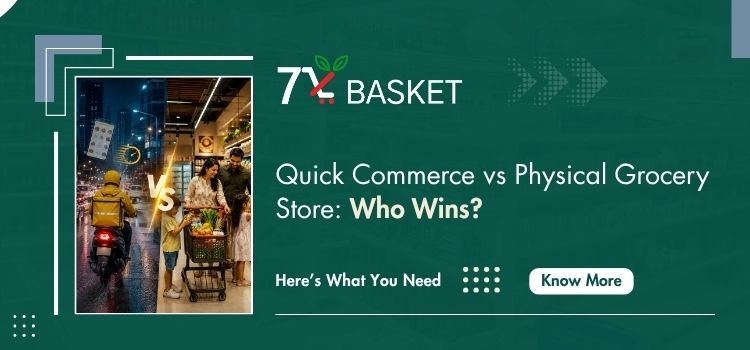
Quick commerce wins on speed, but physical grocery stores and supermarkets still win on price, range, and trust across most of India. Platforms like Blinkit, Zepto, and Swiggy Instamart deliver groceries in 10 to 30 minutes, but they carry a price premium and still haven't proven they can turn a consistent profit at scale. Supermarkets counter with bulk pricing, a far wider product range, and the ability to reach customers in cities quick commerce hasn't gotten to yet. Data from 2025 and 2026 shows quick commerce is actually squeezing supermarkets harder than kirana stores, because both compete for the same planned, monthly shopper. For most Indian households, the outcome isn't replacement. It's a split: quick commerce for the top-up, the physical store for the real shop.
What Is the Difference Between Quick Commerce and Traditional Retail?
Quick commerce delivers groceries from hyperlocal dark stores within 10 to 30 minutes through an app. Traditional retail, which includes supermarkets, grocery franchises, convenience stores, and kirana stores, sells through a physical shop where you walk in, browse, and pay at a counter.
The difference runs deeper than delivery time. A quick commerce platform is a technology and logistics company first, not a retailer in the traditional sense. Most dark stores sit within 2 to 3 km of dense urban pockets and are built purely for fast picking and dispatch, not browsing. Traditional retail depends on a direct relationship with the person walking through the door, something a delivery app structurally can't offer.
There's also a regulatory wrinkle. India caps foreign investment in inventory-led retail at 51 percent, but several quick commerce platforms operate as marketplaces while still controlling inventory and dark stores directly. Regulators are examining whether that holds up, an uncertainty traditional retail doesn't carry.
Quick Commerce in India: What It Gets Right and Where It Breaks Down
Quick commerce's core appeal is speed: groceries delivered in under 30 minutes without leaving home. That convenience has genuinely reshaped urban shopping habits, but the model carries real costs that don't show up until you look past the delivery time.
The Advantages of Quick Commerce
10 to 30 minute delivery from dark stores within 2 to 3 km of the customer
No travel, no queueing, no carrying bags home
Real-time order tracking and one-tap reordering
Genuinely useful for urgent needs: a missing ingredient, milk, a late-night essential
The scale is real. India's quick commerce gross order value grew roughly 24-fold between 2022 and FY25, reaching close to ₹65,645 crore, according to India Briefing and Cornell SC Johnson data. Bain & Company found quick commerce made up about two-thirds of all online grocery orders in India in 2024.
The Disadvantages of Quick Commerce
A price premium: comparable studies found quick commerce baskets running roughly 17 percent higher than supermarket prices, before delivery and handling fees
Profitability still unproven: Blinkit, the market leader, reached adjusted EBITDA breakeven only in Q3 FY26 with a ₹4 crore profit, after a ₹156 crore loss the quarter before
Gig workers face limited job security and pressure to hit unrealistic delivery windows, a concern raised directly by trade bodies like CAIT and AICPDF
Single-use plastic packaging and fuel-intensive delivery are accelerating waste generation
The Competition Commission of India is reviewing allegations of predatory, below-cost pricing against major platforms
Physical Grocery Stores and Supermarkets: Why They're Still Winning
A supermarket wins on the things that matter for most of an Indian household's monthly grocery bill: price, range, quality control, and reach into markets quick commerce hasn't touched yet.
Bulk Pricing and Predictable Costs
Bulk procurement brings down the per-unit cost on staples in a way a small dark store rarely matches. There's no delivery fee, no handling charge, and no minimum cart value standing between a shopper and a fair price. For a planned, monthly stock-up, that difference adds up fast, and it's the single biggest reason supermarkets are better than quick commerce for the bulk of a household's grocery spend.
A Wider Range of Everyday Categories
A supermarket covers far more than groceries: personal care, kitchen items, household supplies, beverages, and stationery, all under one roof. 7x Basket franchise stores, for example, stock over 15,000 products across national brands like Amul, Britannia, Parle, ITC, and Dabur, spanning six core categories across formats ranging from Mini Store to Hyper Store. Categories like personal care and beverages are consistently among the most selling supermarket products, which is part of why one store can replace several specialised ones. Most dark stores run on a narrower set of high-velocity SKUs, since space and speed, not range, are what the model is built for.
Quality You Can Check Before You Pay
In a physical store, you can check the expiry date on a milk carton before it goes in your basket, judge the ripeness of fruit, or ask staff a direct question and get an answer on the spot. None of that is possible when a picker fulfils an order out of sight in a warehouse. That kind of freshness depends on how closely a store manages its grocery store inventory, something dark stores aren't built to optimise for, since their model prioritises speed over shelf life.
Reach Beyond the Metro Cities
Quick commerce's dark store economics depend on dense order volume, which is why platforms are only beginning to test Tier-2 and Tier-3 cities like Jaipur, Lucknow, and Coimbatore as of 2026, and whether the model holds beyond the top 8 to 10 cities is still open. Supermarket franchises don't carry that constraint. Brands like 7x Basket run on direct sourcing from national FMCG brands and a zero-royalty structure for the first two years, keeping shelf prices competitive in markets quick commerce hasn't reached, which is also what a grocery franchise offers over an independent grocery store trying to build that reach alone.
A Relationship Quick Commerce Can't Replicate
A regular customer at a neighbourhood store gets recognised, trusted, and occasionally given flexibility on payment or stock. That loyalty compounds over years of repeat visits in a way an app notification never will, and it's a large part of why supermarket advantages over online grocery delivery hold up even as quick commerce keeps growing.
What Is Quick Commerce's Real Impact on Kirana Stores and Supermarkets?
Quick commerce is hurting supermarkets and slotted e-commerce more than it's hurting kirana stores, even though kiranas get most of the attention in the headlines.
The headline numbers are real. AICPDF data reported in Business Standard puts kirana store closures at close to 200,000, with 90,000 in metro cities, 60,000 in Tier-1 cities, and 50,000 across Tier-2 and Tier-3 markets. Datum Intelligence found kirana market share slipped from 95 percent in 2018 to 92.6 percent in 2023, projected to fall to 88.9 percent by 2028.
But look at who's actually losing the most. India's grocery spending is dominated by over 230 million low and mid-income households making ₹100 to ₹200 baskets, 10 to 20 times a month. At that order size, a quick commerce platform's logistics cost, estimated at 18 to 22 percent of order value, eats most of the margin, making that segment unattractive to chase. What quick commerce is actually capturing is the affluent, planned, monthly stock-up basket that used to belong to supermarkets and slotted e-commerce. About 45 percent of quick commerce users use it strictly for urgent needs, and 24 percent for daily top-ups like milk and bread, a split that lines up with simple frameworks like the 3-3-3 grocery shopping rule. The planned, bulk shop still goes elsewhere, and despite the pressure, supermarket chains remain among the fastest-growing supermarket franchises in India.
So Who Actually Wins, Quick Commerce or the Physical Grocery Store?
Neither wins outright, but the physical grocery store carries the heavier share of the basket. Quick commerce wins the 10-minute top-up. The supermarket wins the planned, bulk, monthly shop, and that basket still represents the larger share of India's roughly ₹55.9 lakh crore grocery market.
What Matters | Quick Commerce | Physical Grocery Store |
Delivery speed | 10–30 minutes | Immediate, in person |
Price on bulk staples | Higher, plus delivery fees | Lower, bulk procurement |
Minimum order / fees | Often required | None |
Product range | Limited, high-velocity SKUs | Broad, full household range |
Quality check before buying | Not possible | Direct inspection |
Reach beyond metro cities | Limited, still expanding | Works across city tiers |
Profitability at scale | Still emerging | Established, predictable |
Final Thought
There's no single winner here, and pretending otherwise misses how Indians actually shop. Quick commerce has earned its place for the urgent, the forgotten, the late-night need. The physical grocery store still owns the planned, value-driven shop that fills most of a household's monthly basket, and it does so with lower prices, better range, and a relationship quick commerce hasn't figured out how to replicate. If you're looking at the grocery retail space as a business opportunity rather than just a shopper, that planned-basket segment is exactly where a structured Supermarket Franchise In India like 7x Basket is built to operate, and it helps to first understand how a grocery franchise model works before taking the next step.