Quick Summary
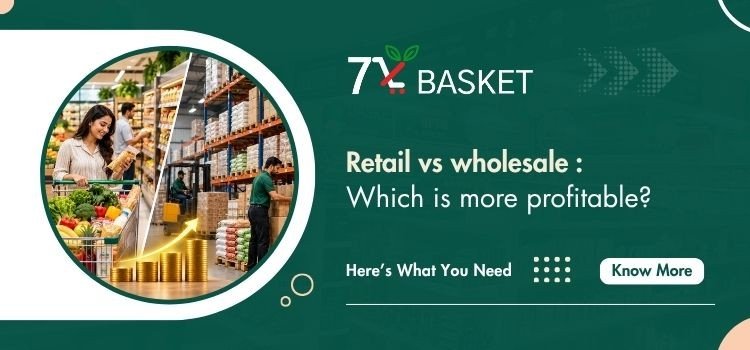
Retail sells small quantities to end customers at higher per-unit margins (15–30% gross on grocery).
Wholesale sells in bulk to other businesses at thinner margins (5–12% gross) but moves far more volume.
Retail needs less starting capital. Wholesale needs more warehouse space and bigger working capital.
Neither model guarantees profit. Your earnings depend on location, demand, management, and cost control.
For most first-time owners with ₹10–30 lakh to invest, a branded retail store is the easier entry point.
Imagine running a wholesale grocery business out of a rented godown. You move decent volume every month. But after paying rent, transport, loader wages, and credit losses from buyers who paid late, your take-home barely crosses ₹18,000. Meanwhile, someone running a small branded retail store on a main road in the same area takes home more, with half the stress.
That situation plays out in towns across India every day. The retail vs wholesale question is not about which model sounds better on paper. It is about which one fits your capital, your skills, and the kind of work you are willing to do every day. Whether you are exploring a supermarket franchise in India or thinking of starting a wholesale operation, the answer depends on your specific numbers.
This guide breaks down real margins, hidden costs, and the daily reality of both models. If you are trying to figure out what kind of grocery business to start, this is the comparison that will help you decide. Note: this is educational content. Have a qualified professional review any business decision before you commit money.
What Retail vs Wholesale Actually Means in India
Before comparing profits, you need to be clear about how each model works on the ground.
Retail: Selling Directly to the End Customer
You buy goods from distributors or wholesalers and sell them one unit at a time to the person who uses them. Customers walk in, pick items off shelves, and pay at the counter. A kirana store, a branded supermarket, and a department store are all retail businesses.
Your margin comes from the difference between what you pay and the MRP you sell at. On grocery items, that gross margin typically sits between 15% and 30%, depending on the category. Staples like atta and rice give you 8–12%. Packaged snacks and personal care products push 20–30%. According to industry data, a kirana store runs a blended gross margin in the high single digits to mid teens, while organised retail formats like supermarket franchises can push that to 20–30% because of better procurement pricing.
If you are curious about how organised retail formats compare to smaller shops, the guide on how grocery franchise models work in India breaks that down in detail.
Wholesale: Selling in Bulk to Other Businesses
You buy goods in large quantities, often directly from manufacturers. You sell them in bulk to retailers, hotels, caterers, or other businesses. Your customers are not consumers. They are other shop owners.
Your margin per unit is thinner, usually 5–12% gross. But you move far more volume per transaction. A single wholesale order might be worth what a retail store sells in a week.
Here is what most articles skip: in Indian grocery franchise markets, many wholesalers also give credit to their buyers, sometimes 15 to 45 days. That credit risk is a real cost that never shows up in the margin percentage. When a buyer defaults or delays payment by months, the wholesaler absorbs that loss.
Wholesale vs Retail Profit Margin: Real Numbers That Matter
This is where most people get confused. A higher margin percentage does not always mean more money in your pocket.
How Retail Margins Work in Grocery
A retail grocery store in India typically earns a blended gross margin of 15–22% across all categories. After rent, electricity, staff salaries, wastage, and billing software, the net profit usually lands between 5% and 10%.
So if your store does ₹5 lakh in monthly sales, your net take-home might be ₹25,000 to ₹50,000. This varies widely by city, store size, product mix, and how well you manage inventory. Even India's largest grocery retailer, D-Mart (Avenue Supermarts), operates on a net profit margin of around 4–5%, which tells you how tight grocery retail margins are at scale.
The guide on how to maximize profit in a mini supermarket franchise covers the specific product categories and operational habits that move those margins.
How Wholesale Margins Work in Grocery
A wholesale business dealing in grocery and FMCG products usually runs a gross margin of 5–12%. After warehouse rent, transport, labour, and credit losses from delayed payments, the net margin often shrinks to 2–5%.
But the monthly turnover is much higher. A wholesale operation doing ₹25 lakh a month at 3% net still nets ₹75,000. The catch: you need significantly more capital locked in inventory and receivables to reach that turnover.
Which Margin Matters More?
The wholesale vs retail profit margin comparison only makes sense when you factor in three things:
Capital required: Wholesale ties up 3–5x more working capital for the same net profit.
Risk of bad debt: Wholesale credit defaults can wipe out months of profit overnight.
Daily effort: Retail needs you at the store. Wholesale needs you chasing payments and managing logistics.
Retail vs Wholesale Business: Side-by-Side Comparison
This table puts the key differences in one place so you can scan and compare quickly.
Factor | Retail (Grocery Store) | Wholesale (FMCG/Grocery) |
Customer type | End consumers (B2C) | Other businesses (B2B) |
Gross margin | 15–30% | 5–12% |
Net margin (typical) | 5–10% | 2–5% |
Starting investment | ₹10–30 lakh | ₹25–75 lakh |
Space needed | 500–2,000 sq ft (shop) | 2,000–10,000 sq ft (godown) |
Working capital locked | Moderate (15–30 days of stock) | High (30–60 days of stock + receivables) |
Credit risk | Low (cash/UPI at counter) | High (15–45 day credit to buyers) |
Staff needed | 2–6 people | 3–10 people + loaders |
Daily involvement | High (store hours) | High (logistics + collections) |
Break-even timeline | 6–18 months (estimate) | 12–24 months (estimate) |
Scalability | Open more stores | Add more product lines or geography |
Brand value | Matters a lot to walk-in customers | Matters less, relationships matter more |
If you are comparing retail or wholesale which is better for your situation, this table gives you the starting point. But the real answer sits in the scorecard below.
Retail or Wholesale: Which Fits You? A Decision Scorecard
Score yourself honestly on each factor. Give yourself 1 point for each statement that is true for you.
Score for Retail:
I have ₹10–30 lakh to invest (including working capital).
I can find a 500–1,500 sq ft shop on a road with good foot traffic.
I am comfortable being at the store 8–10 hours a day, at least in the first year.
I want to build a local brand that people in my neighbourhood trust.
I prefer cash/UPI payments over credit-based selling.
I have no experience managing logistics or large warehouses.
Score for Wholesale:
I have ₹30 lakh or more in liquid capital (not counting property).
I have access to a 2,000+ sq ft warehouse or godown.
I already have contacts with retailers, hotels, or caterers who would buy from me.
I am comfortable giving 15–45 days of credit and chasing collections.
I understand transport, loading, and delivery logistics.
I do not mind lower margins if I can push higher volume.
How to read your score: If you scored 4 or more on the retail side and 2 or fewer on wholesale, retail is likely your better starting point. If you scored high on both, consider starting with retail and adding wholesale distribution later once you understand the supply chain.
Hidden Costs in Retail vs Wholesale That Most Articles Skip
The margin percentages only tell half the story. Here are the costs that eat into your real profit in each model.
Hidden Costs in Retail
Wastage and expiry: Perishables like dairy, bread, and fresh produce can cause 2–5% losses if not managed well.
Theft and shrinkage: Even well-run retail stores lose 1–2% of inventory to pilferage. Industry data from organised retail in India puts shrinkage at 1.5–2.5% of revenue.
Rent escalation: Most shop leases in India have a 5–10% annual rent increase clause. Over 5 years, your rent could jump 25–50%.
Electricity and cooling: A grocery store running chillers and AC can spend ₹8,000–₹20,000 per month on power alone.
Udhaar (informal credit): Many kirana and small supermarket owners give 7–15 days of credit to regular customers. Some of it never comes back.
Hidden Costs in Wholesale
Bad debt from buyers: This is the single biggest risk. If a retailer you supplied goods to on credit shuts shop or delays payment for months, you absorb that loss entirely.
Transport and handling damage: Moving large quantities means breakage, leakage, and spoilage during transit. This can run 1–3% of goods value.
Storage costs: Godown rent, pest control, and insurance for stored inventory adds up fast, especially for perishable categories.
GST compliance burden: Wholesale involves more invoices, more returns, and higher compliance costs. You may need a full-time accountant or CA, adding ₹15,000–₹30,000 per month.
Payment cycle mismatch: You pay manufacturers in 7–15 days. Your buyers pay you in 30–45 days. That gap needs working capital, and the cost of that capital is real.
If you want to understand what a retail setup actually costs from the ground up, the guide on starting a grocery store on a small budget covers the full breakdown. You can also estimate setup cost by store size using a simple calculator.
Why Retail Wins Over Wholesale for Most New Business Owners
If you have never run a business before, retail has some practical advantages that make the first year less risky.
Lower Entry Barrier
You can start a small supermarket franchise in India with ₹10–15 lakh. A wholesale setup of comparable potential needs ₹30 lakh at minimum, often more. For someone using savings or a small business loan, the retail number is simply more reachable.
Cash Flow Is Faster
In retail, customers pay at the counter. Cash, UPI, or card. Your money is in your bank account the same day. In wholesale, you ship goods today and hope to get paid in 30–45 days. That delay is painful when you have EMIs, rent, and staff wages due every month.
Brand Power Works Harder in Retail
A branded store with clean shelves, good lighting, and a recognizable name draws walk-in customers without you having to build relationships from scratch. In wholesale, your name matters less. What matters is your price and your credit terms. The guide on how to start a supermarket franchise with 7x Basket explains how a franchise model handles brand, supply chain, and store setup from day one.
Easier to Learn the Business
Retail teaches you the grocery supply chain at a manageable pace. You learn which products sell, what margins look like, and how customers behave. Many successful wholesalers in India started as retailers first, then expanded backwards into distribution once they understood the market. If you want to see how a supermarket format compares to other small retail formats, the comparison of supermarket vs convenience store is worth reading.
How 7x Basket Makes Your Grocery Franchise Easier to Start
If you are leaning toward retail after reading this, here is what we offer at 7x Basket.
We are a supermarket franchise chain built for people who want to enter grocery retail without building every system from scratch. Our model handles the parts that trip up most new store owners.
Supply chain: Direct relationships with FMCG manufacturers mean better buying prices and daily stock delivery to your store.
Technology: Cloud-based POS and inventory management system from day one. No manual registers or guesswork on reordering.
Brand recognition: You open with a trusted store name and professional store design, not a blank signboard.
Territory protection: Each franchisee gets an exclusive area. No other 7x Basket store opens on your doorstep.
Training and support: Complete staff training before opening, plus a dedicated relationship manager who stays with you through the first year and beyond.
Flexible formats: Mini Store (500–1,000 sq ft), Super Store (1,000–3,000 sq ft), or Hyper Store (3,000+ sq ft), depending on your budget and location.
We do not promise guaranteed returns because no honest business can. What we do promise is a system that gives you a strong starting position in a business where daily demand never stops.
If the retail model fits your scorecard above, you can apply for a franchise and our team will walk you through the numbers for your specific city and budget.
Conclusion: Retail vs Wholesale, the Honest Answer
There is no universal winner in the retail vs wholesale business debate. Both models can work. Both can fail. The difference comes down to your starting position.
If you have limited capital, want faster cash flow, and prefer daily customer interaction, retail is the stronger starting point. If you have deeper pockets, existing trade relationships, and the patience to manage credit cycles, wholesale can deliver solid volume-based returns over time.
What matters more than the model itself is how well you manage costs, control waste, and stay disciplined with money. The best business owners in India are the ones who picked the model that matched their resources, not the one that looked most impressive on paper.
If retail is your answer, a grocery store franchise gives you the brand, supply chain, and systems to start without building everything from scratch. For a deeper look at whether a franchise model is the right investment for you, read the guide on why a grocery franchise is a profitable retail investment.