Quick Summary
Indian farmers keep roughly 30 to 40 percent of what a shopper pays for fresh produce. The rest is absorbed between the farm and the shelf.
RBI survey work puts the farmer's share at about 31 percent for bananas, 35 percent for grapes, and 43 percent for mangoes.
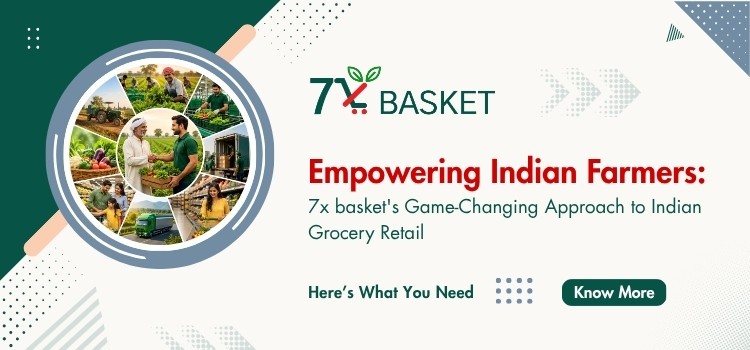
7x Basket buys centrally across 150+ stores in 100+ cities, which cuts stops in the chain and gives suppliers steadier demand.
Every 7x Basket store is FSSAI certified, gets daily fresh stock, and runs automated expiry alerts to cut waste.
Studies place the income gain for farmers supplying organised chains at roughly 14 to 30 percent.
The honest limit: most of any grocery shelf is packaged goods from FMCG brands. The farm impact sits in fresh and dairy, which is a smaller slice of your sales.
Look at the price of tomatoes on a shelf and then at what the grower was paid that morning. The two numbers are rarely close. Everything in between is the cost of moving one crate through four or five pairs of hands.
Short answer: the farmer income gap in India is a supply chain problem, not a pricing problem. 7x Basket works on that gap by buying centrally for the whole network instead of letting each store hunt for stock locally. That is what a Supermarket Franchise in India can genuinely change, and what it cannot.
Why Farmers Earn So Little In India's Grocery Supply Chain
This section explains where the money goes before it reaches the grower.
The Chain Has Too Many Stops
Produce rarely moves from field to shop in one hop. It usually passes a village buyer, a mandi commission agent, a wholesaler, and a city distributor. Each stop adds handling cost, transport cost, and a margin.
RBI survey work across mandis in 16 states found the farmer's share of the consumer price sits between about 33 and 70 percent depending on the crop. For perishables, it sits at the low end.
Perishables Leave No Room To Bargain
Grain can wait. A tomato cannot. If produce does not sell at the mandi that day, the grower accepts whatever is offered rather than lose the batch.
That is why the gap is worst in fruits and vegetables. It is a time problem more than a price problem.
Waste Gets Priced Back Onto The Farmer
India loses an estimated 30 to 40 percent of fruits and vegetables after harvest, mostly to weak cold storage and rough handling. Someone absorbs that loss. Buyers recover it by paying less next round, and that pressure lands back on the grower.
More stops means more cost added before the shelf
Perishables force a same-day sale at any price
Post-harvest loss gets priced into the next purchase
How 7x Basket Sources Farm Fresh Products For Every Grocery Store Franchise
This section covers the four things we do differently on the fresh side, and why each one matters upstream.
Central Procurement Across The Network
We buy for 150+ stores at once instead of letting each store negotiate alone. That gives suppliers one large, repeatable order rather than hundreds of small unpredictable ones, and it removes the local distributor layer that sits between most kirana shops and their stock.
A single shop cannot change how produce is graded or handled. A network placing the same order every week can ask for a standard and keep asking.
Daily Fresh Delivery
Fresh and dairy move on a daily cycle to our stores. Produce sits on the shelf for hours, not days, so less of each delivery dies in a back room.
Shorter time on shelf means fewer write-offs, and fewer write-offs mean we do not have to shrink the next order to cover a loss.
Cold Storage At Store Level
Every store is fitted with cold storage sized for its daily volume. It is part of the store build, not something a partner adds later when spoilage becomes a problem.
Temperature is where most fresh margin quietly disappears in an unorganised shop. Fixing it at the store end protects the whole chain behind it.
FSSAI Certification And Expiry Alerts
Every 7x Basket store is FSSAI certified, so storage and handling follow a legal standard instead of an owner's habit. Our automated expiry system flags stock before it crosses shelf life, so it is discounted or moved rather than thrown.
The same discipline applies to packaged stock, which is why controlling shrinkage and stock loss in a grocery store matters as much as getting a good buying rate.
What A Supermarket Franchise In India Changes For Farmers And Local Suppliers
This section covers the measurable effects of buying this way.
Better Price Realisation
Fewer stops means less cost added between the field and the shelf, so more of the retail price stays with the producer. Research from the Tata-Cornell Institute, published in Economic and Political Weekly, found farmers selling to organised chains earned about 14 percent more on average than those selling through mandi routes.
Demand They Can Plan Around
A supplier who knows a fixed quantity moves every week can plan. Better seed, proper grading, and no panic selling on a bad day.
Rang De's 2025 farmer finance work shows farmers tied to cooperatives and organised procurement networks report income gains of 20 to 30 percent over those relying only on mandi sales. Steady demand does more than one good price ever does.
Less Transport, Less Waste
Every intermediary stage adds a truck trip. Village to mandi, mandi to wholesaler, wholesaler to distributor, distributor to shop. Cutting stops cuts fuel burned and stock damaged in transit.
Be Honest About The Limit
Most of any grocery shelf is packaged goods bought from FMCG brands, not from fields. The farm impact of a supermarket franchise sits in the fresh and dairy corner. It is real, it is measurable, and it is not the whole store. Anyone claiming otherwise is selling you something.
Grocery Franchise Buying vs Standalone Kirana Buying
Here is the practical difference in how stock reaches the shelf.
What Changes | Standalone Kirana | 7x Basket Store |
Where stock comes from | Local distributor or mandi | Central procurement for the network |
Buying rate | Whatever one shop can negotiate | Network volume rate |
Quality standard | Whatever is available that day | Same specification for every store |
Fresh delivery cycle | Irregular | Daily |
Cold storage | Optional, often skipped | Built into the store |
Expiry control | Manual, often missed | Automated alerts |
Food safety | Depends on the owner | FSSAI certified |
Signal to the supplier | Small and unpredictable | Large and repeatable |
The last row is the one that matters upstream. Repeatable demand is what makes a supplier invest in doing the job better.
What Fresh Sourcing Means For Your Supermarket Business
This section is about your money. Fresh behaves differently from the rest of your shelf.
Fresh Brings People In, Staples Pay The Bills
Customers come for fresh items two or three times a week. They come for rice and oil twice a month. That daily visit is what makes the rest of the basket sell.
Judge your fresh section by footfall first, not only by the margin on tomatoes.
Wastage Decides Whether Fresh Makes Money
Fresh carries a higher gross margin than staples, often 20 to 30 percent against 5 to 10 percent. Wastage eats that fast. Cross roughly 8 to 10 percent write-offs and the extra margin is gone.
Daily delivery and expiry alerts reduce that risk. They do not remove it. Culling and rotation are still a daily job on the floor, and that job is yours.
What Stays Your Responsibility
Placing an honest indent every evening for the next morning
Naming one person who culls and re-arranges produce twice a day
Recording write-offs separately from sales so you can see the number weekly
Watching which lines sell out and which ones rot, then changing the order
This is the same shift kirana owners face when moving from a kirana shop to a modern supermarket. The supply gets better. The discipline still has to come from you.
Fresh Section Readiness Scorecard For A New Grocery Store
Tick every line you can honestly tick today. Below seven, fix the gaps before you widen your fresh range.
I know my daily footfall estimate for the location
Cold storage space is planned in my layout
I can receive a fresh delivery every morning
I can place an order every evening for the next day
One named person owns culling and rotation
My billing system records write-offs separately
I check my wastage percentage every week
My FSSAI registration matches my turnover and store size
I have a plan for unsold produce before it hits the bin
I have asked two existing partners about their real fresh wastage
You can estimate your setup cost by store size before going further, especially for a smaller store in a tier 2 or tier 3 market, where rent and footfall economics work differently.
Conclusion
India's farmer income gap comes from a long chain, heavy post-harvest loss, and no bargaining power for anyone holding perishable stock. 7x Basket works on the part it can actually control: central buying, daily delivery, cold storage, FSSAI standards, and expiry alerts that keep waste from travelling back down the chain. Published research puts the gain for farmers supplying organised chains at roughly 14 to 30 percent. For you, the same structure means better rates and a fresh section that can work, as long as you run it tightly. Earnings depend on location, footfall, and management.