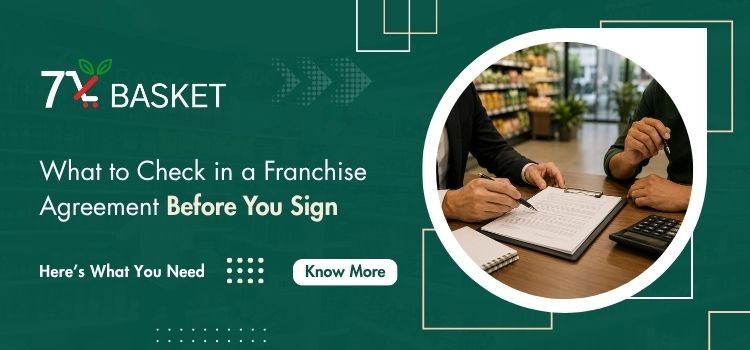
Two shop owners signed supermarket franchise agreements in the same month. One sat with the document for a week and got every verbal promise added in writing. The other skimmed it in an evening, and found his exit penalty a year later.
Before you sign, check every fee and its base, the term and renewal rules, territory rights, supply obligations, written support, and exactly how you exit.
Quick Summary
If you only have two minutes, here is what to look for in a franchise agreement:
Every fee in writing, with its calculation base
Territory protection as a radius or map, not verbal
Notice and cure periods for both sides
Support commitments with names and timelines
A total exit cost calculated before signing
A local lawyer's reading of the full document
What Is A Franchise Agreement?
A franchise agreement is the legal contract between you and the brand you are buying into. It covers what you pay, what you get, what you must do, and how either side exits.
India has no dedicated franchise law, a point most guides skip. Agreements fall under the Indian Contract Act, 1872, and no rule forces franchisors to give you a disclosure document first, as US law does. The contract is your main protection. What is not written does not exist.
New to the model? Start with our guide to how a supermarket franchise works in India. Branded grocery chains are growing fast across tier-2 and tier-3 cities, so more first-timers are signing these contracts than ever.
Franchise Agreement Checklist: The Clauses To Read Closely
Every clause in a supermarket franchise agreement decides either your money or your freedom. Keep this franchise agreement checklist next to you and tick off each one.
Fees and royalties
Every payment named, with its amount and base. A royalty on gross sales is very different from one on margin or purchases. The base matters more than the rate.
Term, renewal, and lock-in
How many years you are committed, what renewal costs, and whether leaving early carries a penalty.
Territory rights
Can another outlet of the same brand open near you? Get your protected area in writing, as a radius or map.
Supply and stock obligations
In a grocery store franchise, stock is your highest recurring cost. Check what you must buy from the franchisor, at what margin, and whether you can source produce locally.
Training and support
Named services with timelines. Who trains your staff, who sets up billing, and who runs the store launch.
Termination and exit
The grounds for ending it, the notice period, the cure period to fix a breach, and the cost of walking away.
Transfer rights
Whether you can sell the store to someone else, and what transfer fee applies. Most agreements also give the franchisor first right to buy or approve your buyer, so check how long that approval takes.
Dispute resolution
Arbitration or courts, and in which city. Fighting a case 800 km from home is a real cost. Arbitration is usually faster than court in India, but confirm who appoints the arbitrator and who pays the cost.
Red Flags In A Supermarket Franchise Contract
Some clauses tell you to negotiate. Others tell you to walk away. Here is the difference in a supermarket franchise contract.
Clause | A fair version | Walk away when |
Royalty | Fixed rate, clearly defined base | Vague base, or it can change without consent |
Territory | Defined area, protection in writing | "We will try not to open nearby" |
Term and renewal | Stated term, renewal conditions listed | Long lock-in plus full fee again at renewal |
Termination | Notice and cure periods for both sides | The franchisor can exit anytime; you cannot |
Support | Named services with timelines | "Assistance as needed" |
Exit cost | Totalled in one clause | Penalties scattered across the document |
The biggest red flag sits outside the document: promises the sales team will not put in writing. Believe the document.
How To Review The Agreement Step By Step
Give this a full week, not an evening.
Read the whole document twice: Once for the shape, once with a pen.
List every payment on one page: One-time, monthly, yearly, conditional.
Get every verbal promise written in: An email helps. A clause in the agreement is best.
Talk to two or three existing franchisees: Anyone running a grocery franchise under the same brand can tell you what surprised them after signing.
Total your exit cost: Lock-in penalty, unsold stock, de-branding. Know this number first.
Have a local lawyer read it: This is general guidance, not legal advice. A lawyer on your specific contract is money well spent.
Compare the deal against staying independent: Our comparison of a franchise vs an independent grocery store weighs both paths.
A Quick Agreement Review Scorecard
Score any agreement you are considering. One point per yes.
Every fee named with amount and base
Royalty base defined in writing
Territory protection specific, not verbal
Renewal terms and costs stated
Supply obligations and margins clear
Support commitments have names and timelines
Both sides have notice and cure periods
Exit costs totalled
Existing franchisees confirm the document
A lawyer has read it
Eight or more: solid. Five to seven: negotiate the gaps first.
Under five: walk away, whatever the brochure says.
How We Do It At 7x Basket
A supermarket franchise model changes the working capital math in three ways. Royalty is zero for your first 2 years, then 1% of monthly sales from year 3, so your heaviest cash-building months carry no royalty outgo. Stock comes through our procurement network at wholesale prices, which lowers your restocking bill. And the cloud billing and inventory software flags slow movers before they trap your cash.
You get a full written breakdown of costs before you decide. The investment calculator gives you a setup estimate by store size, and you can apply for a franchise to see the numbers for your city.
Conclusion
A franchise agreement is not paperwork to get past. It is the business itself, written down. With no separate franchise law in India, the written terms are all the protection you get. Read slowly, get every promise on paper, and total your exit cost first. A brand that welcomes those questions is worth signing with. One that dodges them has answered you already.