A grocery store can carry even hundreds of products and still miss what exactly its customers come in to buy. Actually, the difference lies in properly understanding daily consumption habits, from cooking oil a household replaces every month to the detergent or snack it picks up during a routine visit.
And a carefully planned FMCG product list helps retailers identify essential categories, compare popular brands, and choose products that perfectly suit local buying habits.
In this guide, we’ll cover the major FMCG categories in India, real-world product examples, along with practical stocking decisions in order to help grocery retailers build a range that serves customers and keeps inventory easy to manage.
What Are FMCG Products?
FMCG products are daily items with the fresh consumption of use as well as frequent purchasing. These are products from cooking oil to packaged snacks, toothpaste to laundry detergent, and so much more; things that are essential in fulfilling the day-to-day needs of the average home and that allow retailers to make repeat sales.
Therefore, if one is a grocery owner, there is a need to understand the different types of FMCG products to make sure that they have the right product, control their stock and meet the demands of their customers without overselling.
FMCG Full Form and Meaning
FMCG stands for Fast Moving Consumer Goods. Such products generally sell fast as they are consumed on a regular basis, sold in small quantities and are often available at affordable prices. Some of the most common examples of FMCG products in India are rice, biscuits, tea, soap, shampoo as well as cleaning supplies.
Key Features of FMCG Products
Regular purchases: Customers regularly stock up on everyday essentials.
Fast turnover: Bestsellers fly off the shelves and into the checkout.
Reasonable unit prices: A lot of items are made for everyday penny-pinching buying.
Short shelf life: Perishable items and some packaged goods need to be watched for expiry.
Intense brand rivalry: Customers usually choose between national brands, regional brands and cheap options.
For every retailer, it’s helpful to know these characteristics to build an FMCG range that fulfils local demand and supports efficient inventory management.
FMCG vs Consumer Durables: What Is the Difference?
The main difference between FMCG products and consumer durables is how frequently customers buy and use them. FMCG items are consumed or replaced regularly, while consumer durables are designed to last for years. For grocery retailers, this distinction matters because FMCG sales depend on repeat purchases and stock replenishment, whereas durable goods generally involve higher-value transactions and longer buying cycles.
The main difference between FMCG producers and consumer durables is how frequently customers buy and use them.
FMCG vs Consumer Durables
Factor | FMCG Products | Consumer Durables |
Examples | Biscuits, milk, soap, toothpaste | Refrigerators, TVs, washing machines |
Price per unit | Generally lower | Generally higher |
How often people buy | Daily, weekly, or monthly | Usually every few years |
Shelf life | Often limited, especially for perishable goods | Generally long-lasting with proper care |
Where they are sold | Grocery stores, supermarkets, pharmacies | Electronics stores, appliance showrooms, online retailers |
How sellers earn | Through frequent sales and repeat purchases | Through higher-value sales and product margins |
FMCG Products List: 8 Main Categories With Examples
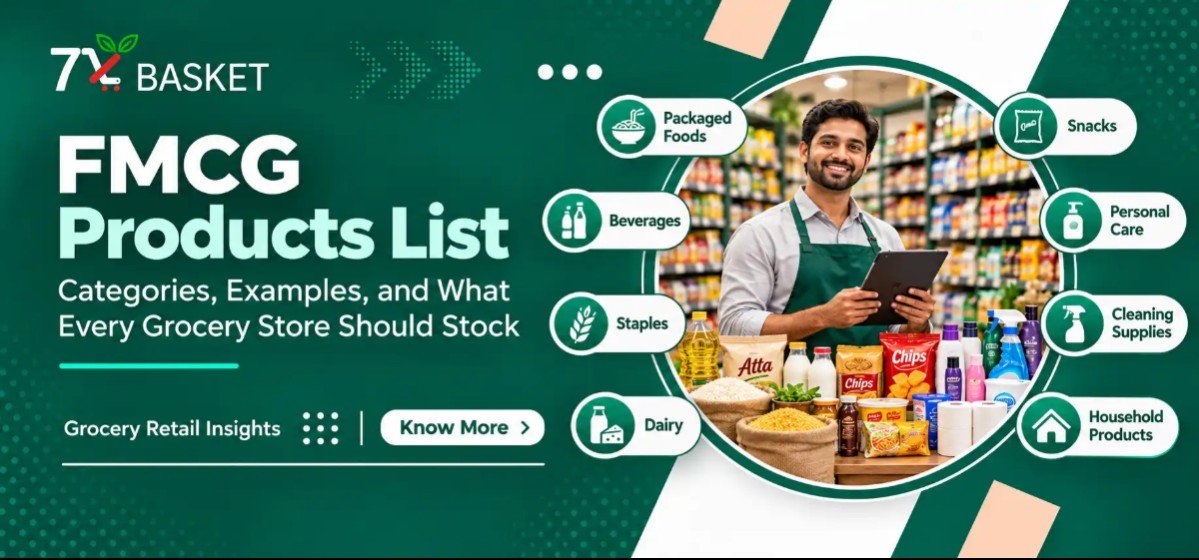
A well-planned list of FMCG products for a grocery store covers everyday essentials across food, beverages, personal care, household cleaning, baby care, and wellness. Understanding these categories helps retailers select relevant products, meet local demand, and manage inventory efficiently
1. Food Staples and Cooking Essentials
These are everyday grocery essentials, including rice, atta, pulses, edible oil, salt, sugar and spices as well. You should offer different pack sizes to suit customers buying daily necessities or monthly rations.
2. Packaged Foods and Snacks
This category includes biscuits, chips, namkeen, noodles, chocolates, breakfast cereals, and instant mixes. Identifying the most-selling supermarket products within these categories helps retailers understand customer preferences and prioritise popular items.
3. Beverages
Common products include tea, coffee, packaged drinking water, soft drinks, juices, and ready-to-drink beverages. Adjust stock according to local preferences and seasonal demand, particularly during warmer months.
Common products include tea, coffee, packaged drinking water, soft drinks, juices, and ready-to-drink beverages. Adjust your stocks
4. Dairy and Frozen Foods
This includes milk, curd, butter, cheese, paneer, ice cream, and frozen snacks. When deciding on stocking, consider how old the food is, how long it will keep in storage, and how much demand its there.
5. Personal Care Products
Soap, shampoo, toothpaste and toothbrushes, hair oil, deodorants, shaving products, and sanitary pads are among the everyday personal care items. Carry regular brands as well as affordable options, catering to different customer preferences.
6. Household and Home Care Products
Examples of these types are laundry detergent, dishwashing liquid, floor cleaning liquids, toilet cleaning liquids, disinfectants, trash bags, and air fresheners. Consider re-stock packs or larger containers to promote purchases of household items.
7. Baby Care Products
Baby-care products include wipes, baby soap, shampoos, diapers, rash creams, and lotions. Popular sizes and trusted brands ensure parents will get their preferred products on a regular basis.
8. OTC Health and Wellness Products
Bandages, antiseptics, first aid kits, thermometers, oral rehydration salts (ORS). Store as instructed and in accordance with the approved licence, especially for those that need a pharmacy licence.
S. No. | Category | Product Examples | Popular Brands in India |
1 | Food Staples and Cooking Essentials | Rice, atta, pulses, edible oil, salt, spices | Aashirvaad, Fortune, Tata Sampann, India Gate |
2 | Packaged Foods and Snacks | Biscuits, chips, namkeen, noodles, chocolates | Parle, Britannia, Haldiram’s, Lay’s, Maggi |
3 | Beverages | Tea, coffee, soft drinks, juices, packaged water | Tata Tea, Red Label, Nescafé, Coca-Cola, Real |
4 | Dairy and Frozen Foods | Milk, curd, butter, cheese, ice cream, frozen snacks | Amul, Mother Dairy, Vadilal, Kwality Wall’s |
5 | Personal Care Products | Soap, shampoo, toothpaste, deodorant, sanitary pads | Dove, Lux, Colgate, Sunsilk, Whisper |
6 | Household and Home Care Products | Detergent, dishwashing liquid, floor cleaner, toilet cleaner | Surf Excel, Vim, Harpic, Lizol, Ghadi |
7 | Baby Care Products | Diapers, wipes, baby shampoo, lotion, rash cream | Pampers, Huggies, Johnson’s Baby, Himalaya BabyCare |
8 | OTC Health and Wellness Products | Bandages, antiseptics, ORS, thermometers | Band-Aid, Dettol, Electral, Omron |
FMCG Products List by Category
The following FMCG product name list includes common products and popular brands available in India. Availability may vary by location and supplier.
S. No. | Category | Product Examples | Popular Brands in India |
1 | Food Staples and Cooking Essentials | Atta, rice, pulses, edible oil, spices, salt | Aashirvaad, Fortune, Tata Sampann, India Gate |
2 | Packaged Foods and Snacks | Biscuits, chips, namkeen, noodles, chocolates | Parle, Britannia, Haldiram’s, Lay’s, Maggi |
3 | Beverages | Tea, coffee, soft drinks, juices, packaged water | Tata Tea, Red Label, Nescafé, Coca-Cola, Real |
4 | Dairy and Frozen Foods | Milk, curd, butter, cheese, ice cream, frozen snacks | Amul, Mother Dairy, Vadilal, Kwality Wall’s |
5 | Personal Care Products | Soap, shampoo, toothpaste, deodorant, sanitary pads | Dove, Lux, Colgate, Sunsilk, Whisper |
6 | Household and Home Care Products | Detergent, dishwashing, floor cleaner, toilet cleaner | Surf Excel, Vim, Harpic, Lizol, Ghadi |
7 | Baby Care Products | Diapers, wipes, baby shampoo, lotion, rash cream | Pampers, Huggies, Johnson’s Baby, Himalaya BabyCare |
8 | OTC Health and Wellness Products | Bandages, antiseptics, ORS, thermometers | Band-Aid, Dettol, Electral, Omron |
For grocery retailers, this list is a starting point, not a fixed stocking formula. Choose products according to local demand, customer budgets, storage capacity, and supplier availability. Prioritise everyday essentials first, then expand the range using sales data and customer requests.
Popular FMCG Companies and Brands in India
Several established FMCG companies in India offer products across food, beverages, personal care, and household essentials. Knowing their key brands helps retailers build a balanced FMCG products list in India that caters to different customer preferences and budgets.
Hindustan Unilever (HUL): Dove, Surf Excel, Lux, Lifebuoy, and Vim.
ITC Limited: Aashirvaad, Sunfeast, Bingo!, and Classmate.
Nestlé India: Maggi, Nescafé, KitKat, and Milkmaid.
Dabur India: Dabur Honey, Real, Vatika, and Dabur Chyawanprash.
Britannia Industries: Good Day, Marie Gold, NutriChoice, and Milk Bikis.
Marico: Parachute, Saffola, and Livon.
Patanjali Ayurved: Patanjali Dant Kanti, ghee, honey, and personal care products.
Procter & Gamble (P&G): Tide, Ariel, Pampers, and Gillette.
Colgate-Palmolive India: Colgate toothpaste and toothbrushes, and Palmolive personal care products.
Amul: Milk, butter, cheese, ghee, ice cream, and other dairy products.
What Every Grocery Store Should Stock: A Simple Checklist
Daily Essentials: Milk, bread, eggs, curd, biscuits, snacks, soap, and toothpaste.
Monthly Ration: Rice, atta, pulses, cooking oil, sugar, salt, and spices.
Checkout Products: Chocolates, candies, toffees, and chewing gum.
Seasonal and Festive Products: Cold drinks, ice creams, sweets, dry fruits, and gift packs.
Local and Regional Products: Regional snacks, namkeen, local brands, and specialty ingredients.
What to Stock by Store Format
Store Format | Store Size | Product Range (SKUs) | Category Focus |
Mini Store | 500–1,000 sq ft | 800–1,500 | Daily essentials |
Super Store | 1,000–3,000 sq ft | 2,000–5,000 | Groceries and household products |
Hyper Store | 3,000–10,000 sq ft | 5,000–12,000+ | Wider product selection |
Fast-Moving vs Slow-Moving FMCG Products in a Grocery Store
Fast-Moving FMCG Products
Milk and bread
Atta, rice, and pulses
Cooking oil, salt, and sugar
Biscuits and packaged snacks
Tea and coffee
Packaged drinking water
Bathing soap and toothpaste
Shampoo and detergent
Dishwashing liquid
Packaged noodles
Slow-Moving FMCG Products
Premium chocolates
Specialty sauces and imported foods
Gourmet snacks
Premium personal care products
Specialty skincare products
Unpopular beverage flavours
Niche hair care products
Less popular breakfast cereals
Specialty cleaning products
Less-demanded product variants
How 7x Basket Helps Franchise Partners Stock the Right Products
7x Basket empowers the franchise partners to plan their grocery mix according to customers' needs and purchasing habits. Key considerations include:
Product selection is essential: Concentrate on staple products like food for everyday use, packaged products, drinks, and household products.
Popular FMCG brands: Have popular FMCG brands on offer, along with inexpensive options for those with budget constraints.
Local demand: Select products that meet local needs and purchasing habits.
Inventory planning: Leverage sales trends to help avoid overstocking slow-moving items.
Balanced product range: Create an FMCG products list that includes key categories and is space-efficient.
Get to know the 7x Basket grocery retail business opportunity and its support.
Conclusion
Profitability in a successful grocery store is more than just having a large selection of products available. The right FMCG product list is what the customer buys and how frequently he is filling those essentials, and which products really deserve the shelf space they occupy.
Analysing sales trends, monitoring product movement, and adjusting stock according to demand are essential for effective grocery store inventory management. Retailers should also monitor expiry dates and avoid tying up capital in products that sell slowly
For those who want to venture into a grocery retail business, 7x Basket will help you understand its franchise model and how to move forward in this domain.